
Single-Phase vs. Three-Phase Electric Boilers:Guide for Installers
When you choose an electric boiler for a heating system, you face a critical decision. You must select the right power configuration. If you choose the wrong model, you risk overloading the building’s electrical system, tripping main breakers, or forcing the client into costly grid upgrades.
For HVAC installers, the choice comes down to understanding the limits of single-phase (220V–240V) and three-phase (380V–415V) electric boilers. This guide helps you match the heating load with the building’s available power based on global standards maintained by the International Electrotechnical Commission (IEC).
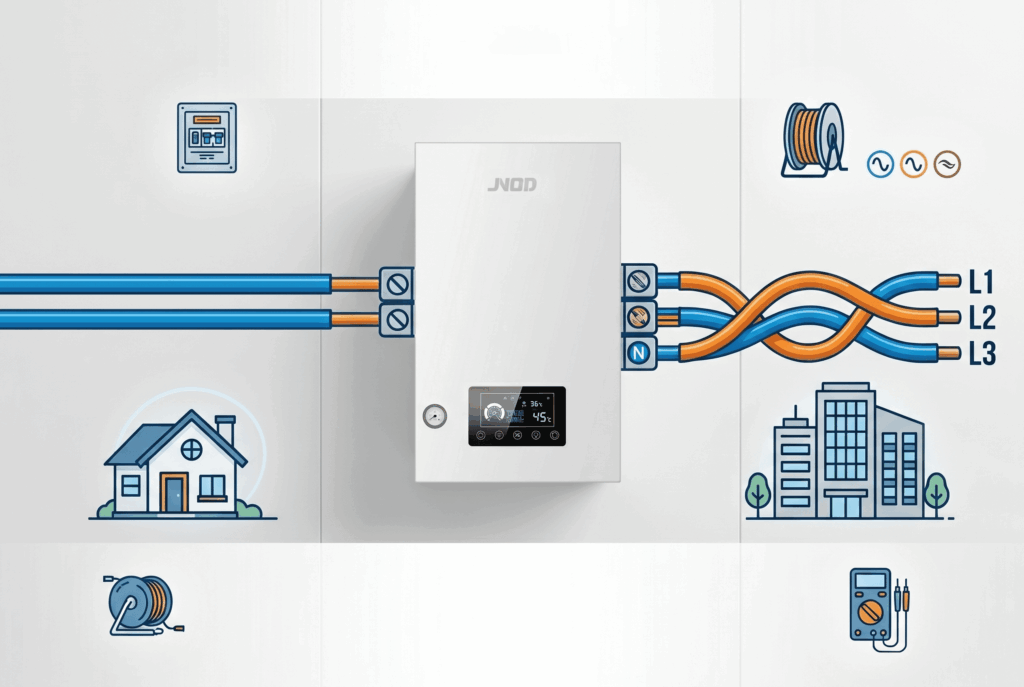
The Real-World Differences
The main difference between single-phase and three-phase electric boilers comes down to kilowatt (kW) capacity and electrical current (amperage).
Single-Phase Electric Boilers (220V–240V)
Single-phase electric boilers deliver power through two wires: one live and one neutral. You will typically find these systems in standard residential homes.
- The Power Limit: Manufacturers usually cap single-phase electric boilers at 12kW to 15kW.
- The Main Problem: High-capacity single-phase boilers draw massive amounts of current. For example, a 12kW electric boiler running on a 230V line draws about 52A. Because many homes only have a 60A or 100A main fuse, running this boiler alongside a kitchen oven or an EV charger will easily overload the main electrical panel. Therefore, you must carefully check the total property load before putting a single-phase unit in place.
Three-Phase Electric Boilers (380V–415V)
Three-phase electric boilers use three active wires instead of one. This setup splits the electrical load across three separate phases.
- The Power Limit: Manufacturers use this setup for larger electric boilers ranging from 12kW up to 100kW or more. You will install these in large luxury homes, commercial spaces, and industrial projects.
- The Main Advantage: Because the system splits the electrical load three ways, the current drops drastically on each wire. Consequently, a 12kW three-phase electric boiler only draws about 17.3A per phase. This lower current allows you to use much thinner supply cables and smaller, safer breakers.
Fast Electrical Reference Chart
This table gives you quick estimates for sizing breakers and cables for different electric boiler capacities. However, you should always verify these estimations against regional installation safety codes, such as the IET BS 7671 Wiring Regulations.
| Boiler Power | Power Type | Current Draw (Approx.) | Recommended Breaker | Typical Copper Cable Size |
| 6kW | Single-Phase (230V) | ~26A | 32A | 4mm² to 6mm² |
| 12kW | Single-Phase (230V) | ~52A | 63A | 10mm² to 16mm² |
| 12kW | Three-Phase (400V) | ~17.3A per phase | 3 × 20A | 2.5mm² to 4mm² |
| 24kW | Three-Phase (400V) | ~34.6A per phase | 3 × 40A | 6mm² to 10mm² |
| 36kW | Three-Phase (400V) | ~52A per phase | 3 × 63A | 10mm² to 16mm² |
When to Choose Which Electric Boiler
Scenario A: Domestic Projects and Home Renovation
- Property Profile: Standard houses or small apartments without a gas grid connection.
- The Best Choice: Single-phase electric boilers (6kW–12kW).
- Your Action Plan: First, calculate the total electrical load of the home. Next, ensure the existing distribution board has room for a dedicated 32A to 63A circuit breaker. Finally, if the house needs more than 12kW of heat, consider installing a hybrid setup. You can pair a smaller single-phase electric boiler with an air-source heat pump to avoid overloading the home’s grid.
Scenario B: Multi-Family Buildings and Commercial Spaces
- Property Profile: Large estates, hotels, apartment buildings, or commercial offices.
- The Best Choice: Three-phase electric boilers (15kW to 45kW and higher).
- Your Action Plan: First, confirm that a three-phase meter is active at the property. Second, check for phase balance. You need to make sure that other heavy equipment in the building does not conflict with the electric boiler, as this can cause a phase voltage unbalance.
Key Installation Safety Rules
Watch the Phase Rotation: Modern three-phase electric boilers feature smart internal controllers and multi-stage pumps. Because of this, you must verify the proper phase rotation ($L1, L2, L3$) during setup. Wrong wiring can cause control board errors or force the pump to spin backward.
- Check the Staged Heating Controls: High-quality electric boilers use sequential heating element activation. Instead of pulling full power instantly, they turn on heating elements in steps (for instance, $4\text{kW} \rightarrow 8\text{kW} \rightarrow 12\text{kW}$). This step-up system protects the building from voltage drops and saves the internal relays from wearing out.
- Tighten All Connections: Single-phase electric boilers run a high current through fewer wires, which creates localized heat. Therefore, you must torque all screw terminals precisely to the manufacturer’s manual. Loose connections create high resistance, which can burn out the boiler’s terminal block.
Source Reliable Electric Boilers for Your Next Project
We manufacture high-efficiency single-phase electric boilers for residential spaces, as well as heavy-duty three-phase electric boilers for demanding commercial jobs. Our units feature smart power modulation to simplify your field installations and protect your clients’ electrical grids.
Contact our support team today for installation guide, technical datasheets, piping layout diagrams, and OEM/ODM options.