
Combi vs. System Electric Boilers: Solving Low Water Pressure in Multi-Unit Buildings
For HVAC distributors, building developers, and mechanical contractors, low water pressure presents a significant challenge when designing efficient heating and domestic hot water (DHW) systems. This issue is particularly prevalent in high-density apartments, historical building retrofits, and commercial properties. As natural gas bans and stringent climate mandates accelerate the global transition toward electrified heating, choosing an electric boiler has become the industry standard.
However, selecting an incompatible boiler model can compromise system performance, leading to insufficient hot water flow and dissatisfied end-users. Navigating the choice between a compact combination (combi) boiler and a storage-based system boiler requires a precise alignment of the building’s plumbing architecture with the appropriate hydraulic pressure strategy.
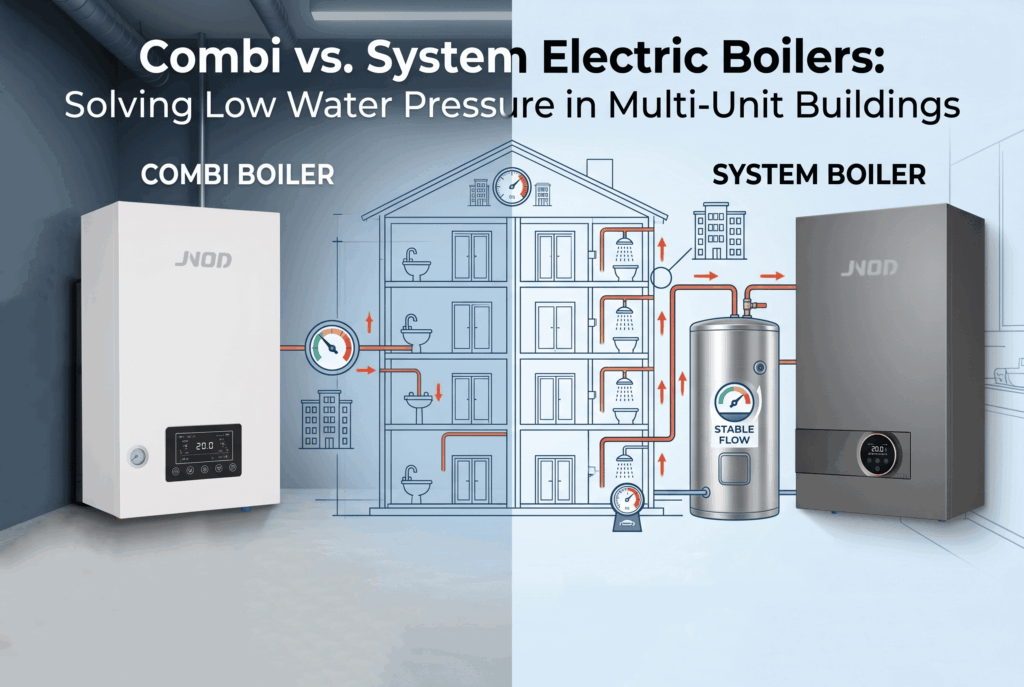
Technical Analysis: Fluid Dynamics & System Architecture
The core operational distinction between an electric combi boiler and an electric system boiler lies in their engineering approach to hydraulic pressure management and domestic hot water delivery.
Electric Combi Boilers
Electric combination boilers engineered for space-constrained environments deliver space heating and instantaneous DHW without the necessity of an external, high-volume water cylinder.
- Pressure Dependency: Combi units heat domestic water dynamically via an internal plate heat exchanger as it flows through the unit. Consequently, the discharge pressure at the tap is entirely dependent upon, and limited by, the incoming municipal main pressure.
- The Low-Pressure Challenge: In scenarios where municipal mains pressure fluctuates, or during periods of simultaneous multi-fixture usage (e.g., multiple showers running concurrently), the available flow rate diminishes rapidly. This performance drop renders standard combi boilers impractical for multi-bathroom properties with high peak-demand profiles.
Electric System Boilers
Electric system boilers are engineered primarily to service closed-loop central heating networks, designed to operate in tandem with an Indirect Water Heater (IWH) or a pressurized hot water storage tank to supply DHW.
- Pressure Decoupling: In a system boiler architecture, DHW delivery is effectively decoupled from municipal mains pressure drops. The boiler utilizes electrical energy to heat a primary fluid loop, which transfers thermal energy via an internal coil to store potable water under stable, regulated pressure within an insulated cylinder.
- The Low-Pressure Fix: When multiple fixtures are opened simultaneously, optimal flow rates and stable temperatures are maintained. This is because the system draws directly from the high-capacity pressurized storage reserve rather than relying on instantaneous, on-demand thermal transfer.
System Configuration Comparison
The matrix below outlines the mechanical and operational parameters of JNOD’s high-efficiency electric boiler portfolios, specifically tailored for high-density residential and light commercial developments.
| Engineering Parameter | Electric Combi Boiler | Electric System Boiler |
| Primary Application | Space-constrained apartments, single-bathroom residences | Multi-bathroom properties, light commercial, multi-zone buildings |
| DHW Delivery Method | Instantaneous heating via internal plate heat exchanger | Stored thermal volume via Indirect Water Heater or Buffer Tank |
| Thermal Efficiency | Up to 99% thermal efficiency | Up to 99% thermal efficiency |
| Mains Pressure Sensitivity | High; discharge flow is bounded by incoming municipal supply | Low; storage tank architecture isolates users from mains fluctuations |
| Simultaneous Fixture Capacity | Limited (ideally 1–2 taps concurrently) | High; constrained only by storage tank capacity and pipe sizing |
| Volumetric Footprint | Ultra-compact; eliminates external cylinder space requirements | Moderate footprint; requires dedicated space for boiler and cylinder |
| Integrated Components | Circulation pump, expansion vessel, internal buffer tank | Circulation pump, safety relief controls, digital user interface |
Architectural Solutions for Low-Pressure Scenarios
When designing HVAC infrastructure for regions characterized by substandard municipal water pressure, mechanical engineers can implement two distinct system configurations based on spatial availability.
1. The Stored-Volume System Configuration (For High Peak Demand)
For multi-story residential buildings, commercial sites, or premium estates experiencing poor mains pressure, the optimal configuration pairs an electric system boiler with an unvented stainless steel or Duplex steel storage cylinder.
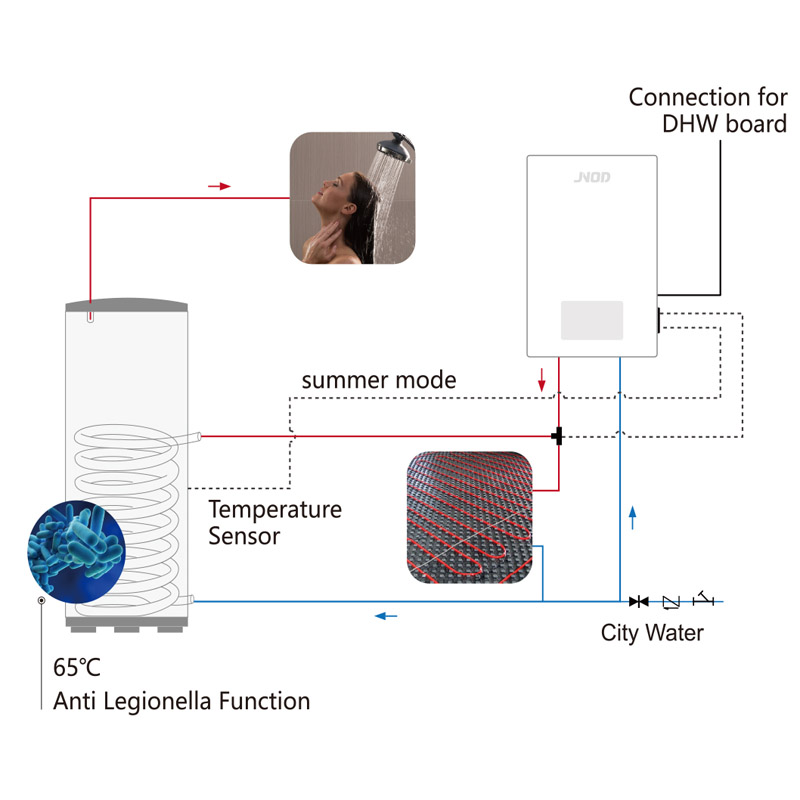
Integrating an upstream booster pump system or a pressurized accumulator stabilizes the incoming supply. The electric system boiler continuously monitors tank temperatures, firing efficiently to replenish thermal reserves. This ensures a high-flow, high-pressure DHW supply across multiple zones simultaneously, fully insulated from external supply drops.
2. Integrated Buffer Combi Configuration (For Spatial Constraints)
In modern urban multi-family complexes where spatial optimization prevents the allocation of a dedicated mechanical room or cylinder closet, a traditional system boiler layout is structurally unfeasible. The engineering solution requires a specialized combination boiler utilizing integrated thermal storage, such as the JNOD BP-E Electric Combi Boiler.
The BP-E series features an integrated 35L pressurized water reserve. By maintaining a localized volume of pre-heated water, the system bridges the operational gap between combi and system architectures—delivering high-flow DHW within 5 seconds of fixture activation. This design optimizes spatial efficiency while mitigating the flow deficits typical of standard low-pressure combi installations.
Manufacturing Quality & Compliance
All critical mechanical and electronic assemblies are manufactured in-house under strict ISO international quality management systems to guarantee field reliability and long-term durability.
- Premium Metallurgy: Internal thermal storage vessels are constructed from high-grade Duplex Stainless Steel 2101. This advanced alloy provides superior tensile strength, exceptional resistance to pitting and stress corrosion cracking, and a significantly extended operational lifespan compared to conventional enamel-lined or standard iron tanks.
- Advanced System Protections: Every boiler platform features an array of automated safety protocols, including multi-stage anti-freezing functions, dual dry-heating prevention sensors, and real-time electronic fault auto-detection.
- Global Certifications: To ensure seamless specification, building code approval, and trouble-free installation across international markets, JNOD product lines carry comprehensive regulatory certifications, including CE, CB, LVD, EMC, ETL, and NSF markings.
Business FAQ
What is the Minimum Order Quantity (MOQ) for international commercial procurement?
Our supply structures are engineered to accommodate high-volume distributors, wholesale purchasing networks, and large-scale commercial construction projects. For specific project bidding, custom OEM/ODM requests, or introductory sample evaluations, please contact our international commercial sales division.
How does JNOD guarantee supply chain stability for large-scale construction schedules?
JNOD operates a fully optimized, vertically integrated manufacturing facility boasting a reliable annual production capacity of 200,000 units. By fabricatng our own proprietary heat exchangers, electronic control boards, and structural enclosures in-house, we eliminate third-party supply chain bottlenecks, guaranteeing predictable lead times and on-time delivery for your project milestones.
Can JNOD electric boilers integrate with Building Management Systems (BMS)?
Yes. Select commercial and residential JNOD models come equipped with smart IoT-enabled control processors and independent app connectivity. This allows mechanical contractors, facility engineers, and property managers to remotely monitor system diagnostics, modulate target temperatures, and manage multi-zone heating parameters efficiently.
Direct Procurement Channel
Are you a project engineer, HVAC contractor, or wholesale distributor seeking detailed technical datasheets, CAD/Revit BIM models, or volume contract pricing for an upcoming commercial or residential development? Contact our global engineering support team directly.