
Can You Heat a 300㎡ House in Sub-Zero Winters with an Electric Boiler?
When winter temperatures drop below freezing, keeping a large 300 m² property warm is a massive challenge. Because of this, many homeowners, property developers, and installers wonder if a high-capacity electric boiler can reliably handle such a heavy heating workload.
⏱️ Quick Verdict: Is it Feasible?
Yes, it is entirely feasible. Heating a 300 m² space in sub-zero climates requires a continuous heating capacity between 24 kW and 48 kW. To run a system this size, a 3-phase 380V electrical connection is completely mandatory. While electric boilers offer unmatched reliability in extreme cold with zero performance drop, keeping running costs low requires a smart installation setup, such as pairing the boiler with a thermal storage buffer tank or a hybrid heat pump.
Calculating the True Heating Demand for Large Spaces
To figure out if an electric boiler is right for your project, you must first calculate the specific heat loss and heating demand of the building. In severe sub-zero climates, the amount of power required per square meter changes dramatically based on the property’s insulation quality. According to building performance standards outlined by the CIBSE (Chartered Institution of Building Services Engineers), calculating peak heat loss is the essential first step before sizing any commercial or residential heating plant.
You can estimate your baseline needs using a straightforward calculation:
Required Capacity = 300 m² X Heat Demand per m²
- Excellent Insulation (Modern Passive Houses): These buildings need around 70 W/m². As a result, they require a 21 kW to 24 kW boiler capacity.
- Average Insulation (Double Glazing & Insulated Walls): These properties require roughly 100 W/m². Therefore, they need a mid-sized 30 kW boiler.
- Poor Insulation (Older Homes or High Ceilings): Conversely, older structures demand 130 W/m² or more. That means you will need a heavy-duty 36 kW to 40 kW+ boiler.
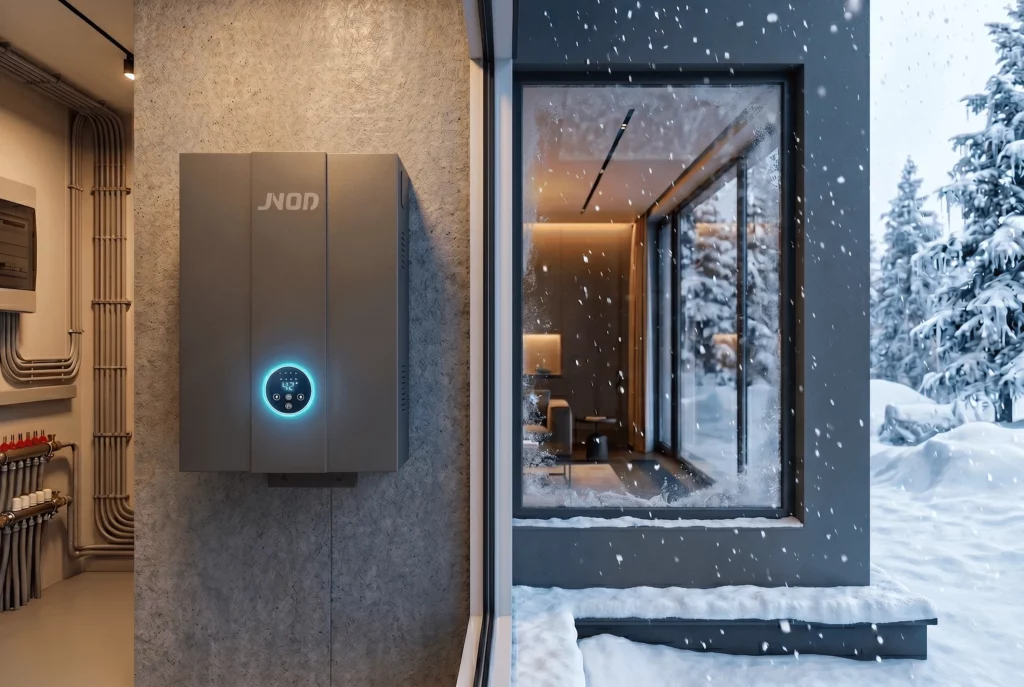
To put it simply, while a standard 300 m² residential home typically needs up to 36 kW, larger luxury estates, multi-floor properties, or light commercial spaces often face much higher peak heating loads. When scaling up to meet these heavy demands, standard domestic units fall short. This is exactly where heavy-duty commercial equipment like the JNOD BKN Electric Open-vented Boiler Series becomes necessary to prevent any drop in indoor room temperatures.
Grid Requirements & Technical Specifications
Because high-capacity boilers demand massive amounts of energy, standard single-phase residential electrical connections simply cannot handle the load. For systems of this scale, a three-phase power supply (380V) is required to safely manage the electrical current.
For a detailed breakdown of how multi-phase electrical infrastructure supports heavy commercial machinery, you can review the IEEE Standards Association guidelines on industrial power systems.
According to the official engineering data for the series:
| Technical Parameter | BKN348 Model | BKN368 Model |
| Rated Power | 48 kW | 68 kW |
| Phase / Voltage | 3-Phase / 380V | 3-Phase / 380V |
| Rated Current | 72.7 A | 103 A |
| Wire Section | 5 X 16 mm² | 5 X 25 mm² |
| Circuit Breaker | 100A | 125A |
| Max. Water Temperature | 80 °C | 80 °C |
| Product Size | 598 * 813 *196 mm | 833 * 813 *196 mm |
That means before choosing a 48 kW or 68 kW system, you must ensure your property’s main circuit breaker and local grid infrastructure can handle the amperage draw. This is crucial because the system must run smoothly alongside your other everyday appliances, like electric vehicle chargers or heavy machinery.
Crucial Advantages of Commercial Electric Boilers in Deep Freezes
It is a well-known fact that traditional air-source heat pumps lose significant efficiency and heating capacity when outdoor temperatures plummet below -15°C. In contrast, commercial electric boilers maintain their peak performance no matter how cold it gets outside.
The design of the series brings several major advantages to large-scale projects and commercial spaces:
- Zero Thermal Decay: These boilers deliver high rated thermal outputs (46kW to 70kW). That means they heat up large properties rapidly and maintain a completely stable heat supply across multiple rooms simultaneously with absolutely no drop in performance.
- Complete System Installation Freedom: The compact chassis is designed with no built-in water pump or expansion tank. This is a massive benefit for installers because it allows them to freely select external pumps and large expansion tanks that match the exact plumbing layout. Ultimately, this ensures the system handles long piping runs and massive water volumes without factory-preset component bottlenecks.
- Seamless Multi-Unit Scalability: The system natively supports parallel joint control for multiple units. For instance, if a commercial property expands, adds new building sections, or increases its total heated area later on, you can directly daisy-chain extra boilers into the existing system with zero hassle.
- Low Maintenance and Low Capital Costs: Compared to large, commercial-sized heat pumps or complex biomass setups, high-capacity electric boilers are significantly cheaper to purchase and install. Additionally, with very few moving parts, they run silently and require minimal annual maintenance.
Smart Cost-Reduction Strategies for Electric Heating
Running a high-capacity electric boiler continuously in the dead of winter can lead to high utility bills if your system is not optimized. Fortunately, you can easily implement a few proven strategies to maximize efficiency and cut down your running costs:
1. Integrate a Thermal Storage Buffer Tank
First, you can couple your boiler with a large external buffer tank (500L to 1000L). This setup allows you to run the boiler during the night to heat up the water storage using cheap, off-peak electricity tariffs. Afterward, the system can distribute that stored heat throughout the property during peak daytime hours without turning the boiler back on.
2. Configure a Hybrid Heat Pump Setup
Alternatively, you can build a hybrid heating system. In this design, a highly efficient air-source heat pump handles the baseline heating during moderate winter days. However, when an extreme sub-zero cold snap hits, the high-capacity electric boiler automatically kicks in as a powerful booster to keep the space perfectly warm.
3. Pair with Low-Temperature Underfloor Heating
Finally, high-capacity electric boilers pair beautifully with hydronic underfloor heating. This matters because underfloor systems only require a low water flow temperature (35°C to 45°C) to successfully warm a room. On the other hand, traditional radiators require much higher temperatures (60°C to 75°C). Choosing underfloor heating over radiators drastically reduces your daily power consumption.
Frequently Asked Questions (FAQs)
Is an electric boiler or a heat pump better for sub-zero climates?
Air-source heat pumps are incredibly efficient in mild weather, but their performance drops sharply in deep freezes. Electric boilers are far more reliable in extreme cold because they provide 100% of their heating capacity even at -25°C without needing backup heaters. Many large properties use a hybrid system combining both for the best balance of efficiency and reliability.
Can a residential house support a 48 kW electric boiler?
A standard residential home cannot support a 48 kW boiler on a typical single-phase electrical supply. To run a high-capacity system safely, your property must have access to a 3-phase 380V power connection with an appropriate circuit breaker.
What commercial buildings are best suited for high-capacity electric boilers?
Because of their rapid heating capability and high water temperature output (up to 80 °C), these systems are ideal for whole-building centralized heating in hotels, apartment complexes, commercial offices, factories, and large-scale holiday homes.
Conclusion
To sum it all up, heating a 300 m² space in sub-zero winters with an electric boiler is highly dependable as long as you have a 3-phase electrical connection ready. Commercial-grade systems deliver rapid, steady warmth without losing power when the weather is at its worst. To maximize your return on investment and keep your monthly energy bills low, simply combine your boiler with a thermal storage buffer tank or run it alongside a heat pump.
Upgrade Your Heating System Today
Are you ready to secure reliable, powerful warmth for your property this winter? Explore the heavy-duty JNOD BKN Electric Open-vented Boiler Series to find the perfect fit for your project’s heating load. Contact our expert technical support team today for a custom system design and a free quote!