
Does Electric Boiler Installation Require Electrical Upgrade?
Quick Answer: Installing an electric boiler often requires an electrical service panel upgrade. Most modern residential electric boilers draw between 40 to 100 amps at 240 volts. If your property currently operates on an older 100-amp to 150-amp main service panel, upgrading to 200 amps is typically required to prevent main breaker trips during peak heating demand.
Evaluating Total Electrical Load Before Installation
Contractors frequently encounter panel capacity limitations during electric boiler installations. A building owner may choose electric hydronic heating to reduce onsite carbon emissions, only for the electrician to halt installation during rough-in because the main service panel lacks sufficient headroom. Transitioning from fossil fuel to high-kW electric heating requires evaluating total building electrical demand alongside hydronic piping design. At JNOD, we design electric boilers for residential and light commercial retrofits, and we advise installers to audit total service panel capacity before specifying boiler output.
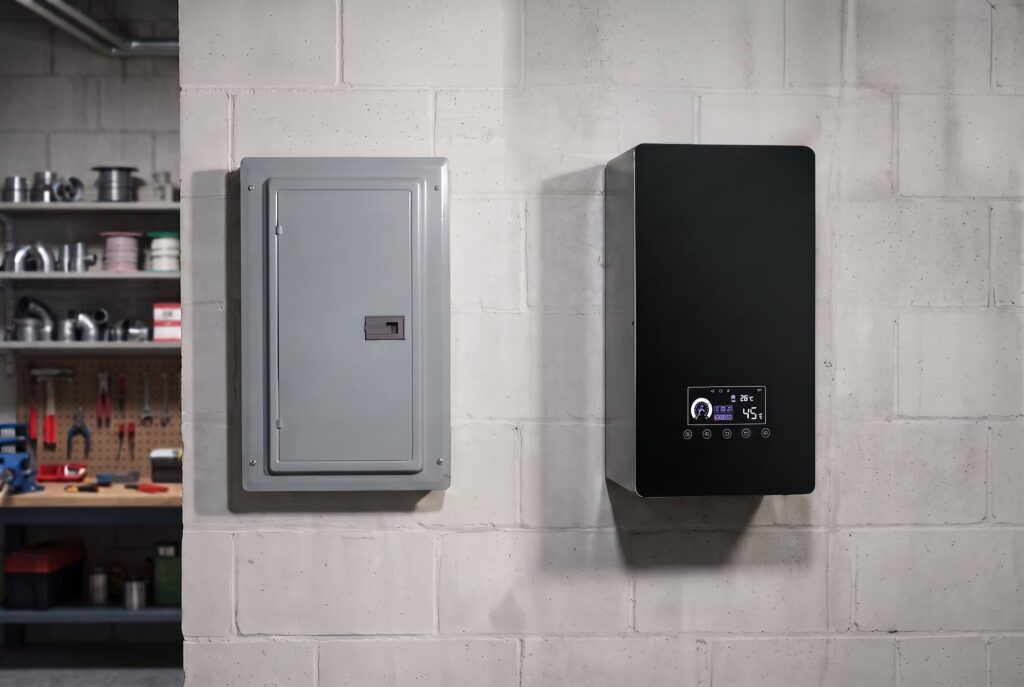
Load Calculations: Evaluating Your Current Panel
Evaluating electrical headroom requires calculating total connected load according to local electrical codes rather than estimating panel space visually.
1. Ampere Rating and Main Breakers
Many existing homes operate on a 100-amp to 150-amp main distribution panel. A typical 12 kW electric boiler draws 50 amps under full load. When operated alongside other major appliances such as an electric range, clothes dryer, or water heater, total system demand easily exceeds a 100-amp threshold. According to safety standards published in the National Electrical Code (NEC) Article 220 continuous load sizing guidelines, continuous electrical loads must not exceed 80% of the main service panel’s rated capacity.
2. Dedicated Circuits and Breaker Space
An electric boiler requires a dedicated double-pole breaker setup. Larger heating units utilize multiple element banks, requiring two or three double-pole breakers. If the main distribution board is fully populated, installing a subpanel or upgrading the main service entrance becomes necessary. An ele
Wiring and Safety: Wire Gauge and Overcurrent Protection
Correct cable sizing prevents resistance heating and insulation breakdown within conduit runs.
Heavy-Gauge Conductors
High-amperage heating circuits require larger conductor cross-sections. A standard 50-amp boiler circuit requires 6 AWG copper wire, whereas an 80-amp multi-stage unit typically specifies 2 AWG copper conductors. Using undersized conductors or aluminum wiring without rated pressure terminals increases contact resistance, which leads to terminal block damage over extended heating cycles.
Grounding and ELCB Protection
Electric boilers integrate high-voltage heating elements within fluid circuits. Internal heating elements must be bonded to the main grounding system to prevent current leakage through hydronic piping. Modern control architecture integrates Earth Leakage Circuit Breakers (ELCB) that disconnect power to the heating elements if a ground fault is detected.
Technical Design: Mitigating Inrush Current via Staggered Energization
Integrating high-capacity electric boilers into existing panel architectures requires managing load-switching logic to protect main service limits.
Traditional electric boilers often energize all heating element banks simultaneously when the room thermostat calls for heat. This sudden load step creates an inrush current draw on the service panel, causing line voltage sag that can trip sensitive main breakers if secondary high-draw appliances are active.
To prevent line disturbance, JNOD integrates a stepped power control module across our electric boiler lineup. Instead of switching on at 100% capacity, the onboard microcontroller steps the heating elements on in sequence with a staggered time delay between stages. According to power quality research published in IEEE standards on voltage sag and transient load switching, staggered energization minimizes voltage drop across residential distribution transformers and prevents premature thermal tripping on main service breakers.
Technical Comparison: Panel Capacity vs. Boiler Output
| Boiler Output | Current Draw (230V–240V) | Dedicated Protection | Panel / Board Type | Wire Gauge (US / EU) |
| 6 kW | ~25 Amps | 30A Double-Pole / MCB | 100A Panel / Consumer Unit | 10 AWG / 6 mm² |
| 12 kW | ~50 Amps | 60A Double-Pole / MCB | 150A Panel / Distribution Board | 6 AWG / 10 mm² |
| 18 kW | ~75 Amps | 2x50A Double-Pole / MCB | 200A Panel / Distribution Board | 2 x 8 AWG / 16 mm² |
| 24 kW | ~100 Amps | 2x60A Double-Pole / MCB | 200A+ Panel / Distribution Board | 2 x 6 AWG / 25 mm² |
Engineering Strategies for Panel Bottlenecks
When service panel upgrades are constrained by utility hookup limits or budget, two practical workarounds can be evaluated.
Option 1: Automatic Load Management
When upgrading a main panel is impractical, an automatic load-shedding relay can be installed. This controller temporarily reduces or interrupts power to non-critical heating stages when primary appliances, such as an electric oven or EV charger, draw peak power.
Option 2: Lowering Supply Water Temperature
Reducing required peak wattage is possible by optimizing supply water temperature. Setting hydronic distribution loops to 45°C for radiant floor systems requires significantly less power input than maintaining 75°C for conventional cast-iron radiators, allowing the specification of a lower kW boiler.
Conclusion: Verifying Capacity Prior to Installation
Electric boilers provide clean, low-maintenance hydronic heating, but verifying electrical capacity is a prerequisite. Auditing panel amperage and specifying correct wire gauges before installation avoids unexpected electrical delays during construction. JNOD manufactures electric boilers with staged power switching to assist contractors in completing reliable hydronic heating retrofits.
FAQ
How do I determine if an electrical panel can support an electric boiler?
Calculate total household electrical load by subtracting existing major appliance amperage from 80% of the main panel rating. If the remaining capacity is lower than the boiler’s full-load amperage, a panel upgrade is necessary.
Do I need a licensed electrician to install an electric boiler?
Yes. Electric boilers require 240V hardwiring, dedicated breakers, 24V thermostat control wiring, and grounding. Local codes require a licensed electrician for safety, permits, and warranty validation.
Is an electric boiler less expensive to install than a gas boiler?
Installation for the boiler unit itself and hydronic connections is often simpler because electric boilers require no gas lines or venting flues.
How do I know if my 100-amp panel can handle an electric boiler?
Subtract your current household appliance load from 80% of your panel capacity (80A for a 100A panel). If the remaining capacity is less than the boiler’s full draw (e.g., 50A for a 12 kW unit), you need a 200A panel upgrade.
Technical Support and Specifications
Avoid installation delays caused by service panel limitations. JNOD manufactures compact, high-efficiency electric boilers designed for precise power modulation and long service life.
Contact JNOD’s Engineering Team to request electrical wiring schematics, technical load sheets, or OEM specification documents for your next project.