
the 2026 Boiler Industry Shift: Why Hybrid and High-Efficiency Systems Lead
The End of Single-Fuel Specification
Single-fuel commercial heating is becoming obsolete.
Recent data from the PHCPPros 2026 Boiler Report makes one reality clear—no single boiler technology can address every building requirement on its own.
At JNOD, we work directly with mechanical engineering firms across North America and Europe. The feedback is unanimous.
Building owners want to decarbonize, but they cannot afford complete electrical infrastructure overhauls. Pairing high-efficiency electric boilers with existing hydronic loops or heat pumps bridges this exact gap.
The Flaws in Single-Source Heating Strategies
Relying on one fuel source creates distinct operational liabilities in 2026.
- Fossil Fuel Compliance Pressures: Building performance standards outlined by the US Department of Energy building energy codes continue to penalize direct combustion systems. Gas boilers face shrinking subsidy eligibility and rising carbon surcharges.
- Heat Pump Thermal Limits: Air-source heat pumps offer exceptional seasonal COP during mild conditions. What happens when ambient temperatures crash below -15°C? Thermal output plummets right when building heat loss peaks.
- Electrical Service Bottlenecks: Replacing a gas boiler with a massive standalone heat pump array often demands hundreds of additional electrical amperes. Transformer upgrades take months and cost small fortunes.
How Electric Boilers Power Hybrid Hydronic Architectures
Hybrid integration is not a compromise. It is an optimization strategy.
By inserting a high-efficiency electric boiler into a primary-secondary hydronic loop, mechanical engineers achieve true load separation. The primary heat pump maintains the base low-temperature loop (45°C to 50°C).
When outdoor temperatures plunge or domestic hot water demand spikes, the electric boiler steps in as the secondary booster.
System precision depends on how smoothly energy ramps up.
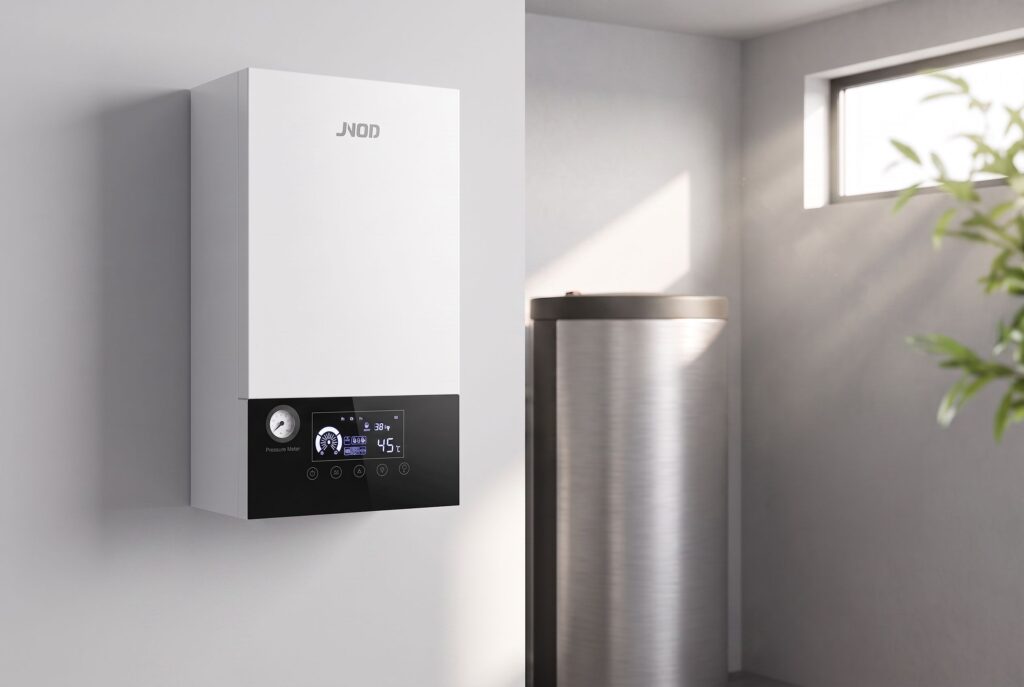
At JNOD, we equip our commercial electric boiler series with solid-state SCR (Silicon Controlled Rectifier) power modulation. Instead of rough step-staging that triggers power surges, our units adjust power draw in fluid 1% increments.
The system draws only the exact wattage required to satisfy the live thermal deficit.
We also replace vulnerable immersion heating elements with heavy-duty cast aluminum heating blocks. The heating elements are completely embedded within the cast aluminum structure, keeping electrical components entirely separated from the water stream.
This integrated cast-aluminum channel dissipates heat rapidly across a wide surface area. It eliminates localized hot spots that trigger mineral scaling while protecting the heating core against mechanical stress and thermal shock during sudden cold starts.
Performance Metrics Across Heating Configurations
| Evaluation Criteria | Standalone Gas Boiler | Standalone Air Heat Pump | JNOD Hybrid Electric System |
| Heating Core Technology | Burner / Combustion Chamber | Compressor / Plate Exchanger | Cast Aluminum Heating Block (Water-Electric Separated) |
| Emissions Profile | Direct On-Site Emissions | Zero Direct Emissions | Zero Direct Emissions |
| Cold-Weather Reliability | High (Fuel Dependent) | Low to Moderate | 100% Reliable (Up to 85°C Flow Temp) |
| Maintenance & Longevity | High Maintenance (Scaling/Soot) | Moderate | Low Maintenance (Scale-Resistant Dry-Heating Element) |
| Power Grid Impact | Low | High (Large Compressor Amperage) | Managed (SCR Modulated) |
| Capital Cost vs Return | Moderate / High Penalty Risk | Very High Initial Investment | Optimized Capital Expense |
Practical Integration Features for Retrofit Mechanical Rooms
Retrofitting tight mechanical spaces requires pragmatic equipment design.
BMS Load-Shedding Interfaces
Peak demand charges can ruin operating budgets!
Our electric boilers incorporate native Modbus and BACnet communications. When building electrical consumption nears site limits, the onboard controller throttles boiler wattage instantly to protect the main breaker.
Minimal Footprint Layouts
Equipment room space is limited.
JNOD designs compact vertical electric boilers with zero side-clearance requirements, allowing easy transport through standard door frames and passenger elevators.
Summary: Adapting to Modern Hydronic Demands
The 2026 commercial heating market rewards operational flexibility.
Designing around a single fuel type exposes facilities to regulatory fines and performance bottlenecks. JNOD produces modulated, high-efficiency electric boilers engineered to integrate seamlessly into hybrid hydronic loops.
Frequently Asked Questions
Why are engineers moving away from single-boiler specifications in 2026?
No single heating technology handles extreme weather, low carbon targets, and operating costs simultaneously. Hybrid configurations combine the efficiency of heat pumps with the rapid high-temperature recovery of electric boilers.
How does SCR modulation improve electric boiler performance?
SCR modulation continuously adjusts power input in 1% increments. This eliminates high-current electrical spikes, stabilizes loop supply temperatures, and reduces mechanical strain on heating elements.
What is the advantage of JNOD’s cast aluminum heating block over traditional immersion heaters?
Cast aluminum heating blocks feature complete water-and-electricity separation, eliminating electric leakage risks. The high thermal conductivity of aluminum distributes heat evenly, preventing local hot spots, scale buildup, and thermal shock.
Can JNOD electric boilers operate with existing Building Management Systems?
Yes. Our commercial controls support standard BMS protocols for automated load shedding, temperature setback, and remote system diagnostics.
Request Technical Specifications
Build resilient, future-ready heating systems with JNOD. We supply engineering contractors and commercial distributors with high-output electric boilers designed for complex hybrid installations.
Inquiry to download engineering drawings, CAD files, and technical product catalogs.