
Electric Boiler for Home Heating: How to Choose
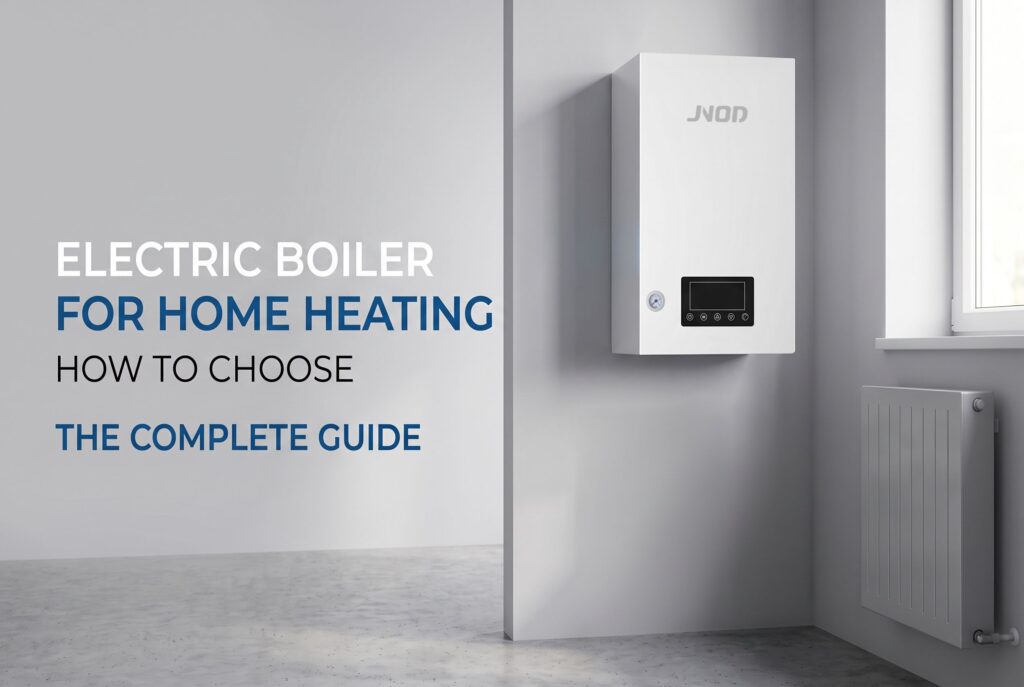
Quick Answer
Yes. An electric boiler can be a reliable primary heating system for a home.
It needs no gas connection or chimney. It can work with radiators or underfloor heating, and modern models can support room thermostats, Wi-Fi control, and smart scheduling.
But there is one rule we always follow at JNOD: size the heating system first, then choose the boiler.
The boiler is only one part of the system. Heat loss, electrical capacity, water flow, domestic hot water demand, and controls all affect the final result.
Why Choose an Electric Boiler for Home Heating?
Electric boilers are simple by design.
Electricity heats the water. A circulation system then sends hot water to radiators or underfloor heating. There is no burner, flue, fuel tank, or combustion process.
That makes electric boilers useful for homes where gas is unavailable or a chimney is not practical. They are also compact, quiet, and relatively easy to install.
For a well-designed system, the main advantage is predictability. You know the available heating output, you can control the water temperature accurately, and routine maintenance is usually straightforward.
But we would not say an electric boiler is the best solution for every house. The building and local energy costs always come first.
Electric Boiler vs. Electric Combi Boiler
The choice mainly depends on domestic hot water.
| Feature | Electric System Boiler | Electric Combi Boiler |
|---|---|---|
| Space heating | Yes | Yes |
| Domestic hot water | With hot water cylinder | On demand |
| Installation space | Small | Very compact |
| High DHW demand | Better with cylinder | More limited |
| Best suited to | Larger homes | Apartments and smaller homes |
| Main consideration | Cylinder size | Boiler power and water flow |
A system boiler is often a better choice for a family home with higher hot water demand. A cylinder stores hot water, so several outlets can be used with less impact on instant boiler output.
An electric combi boiler is attractive when space is limited. It provides heating and domestic hot water from one wall-mounted unit, but its hot water performance depends directly on electrical power and water flow.
There is no universal winner.
Choose the system around the house, not the other way around.
In the EU, electric resistance boilers and combination heaters are covered by the Ecodesign framework for space heaters. For combination boilers, space heating and domestic hot water performance are assessed separately. European Commission: Space Heaters
How to Choose the Right Electric Boiler
Calculate Heat Loss First
Floor area is not enough.
A 120 m² well-insulated house can have a much lower heat demand than a poorly insulated house of the same size. Windows, insulation, ventilation, outdoor temperature, and air leakage all matter.
We recommend a proper heat-loss calculation before selecting boiler output.
Oversizing is not automatically better. The boiler should provide enough capacity for the design condition while allowing sensible control during milder weather.
Check the Electrical Supply
This is one of the most important points.
A 12 kW boiler connected to a 230 V single-phase supply can draw around 52 A at full output. That load must be considered together with the rest of the house.
The installer should check the incoming supply, breaker, cable, phase configuration, voltage, cable length, and other major loads.
For higher-power models, three-phase supply can make the electrical design more practical.
Never select the cable size from the boiler power alone. The complete installation must comply with the applicable electrical requirements and the manufacturer’s instructions.
Decide How You Want Domestic Hot Water
Heating and hot water have different demands.
If the home needs a lot of hot water, a separate cylinder can be a better solution. If space is limited and hot water demand is moderate, an electric combi boiler can make more sense.
This is one reason we offer different configurations at JNOD.
Consider Smart Controls
Modern electric boilers can work with room thermostats, timers, Wi-Fi control, and weather compensation.
The purpose is simple: use only the heating output the building actually needs.
Smart control does not change the basic heating principle. It simply makes the system respond better to real demand.
JNOD Electric Boilers for Residential Heating
At JNOD, we manufacture wall-mounted electric boilers for residential hydronic heating.
Our range includes electric system boilers, open-vented boilers, and electric combi boilers for different heating and domestic hot water requirements.
We pay particular attention to the parts that affect real installation and service.
Depending on the model, our electric boilers can integrate components such as a circulation pump, expansion vessel, safety protection, anti-freeze protection, overheat protection, and smart controls.
Why does this matter?
Because a boiler should not only work in a laboratory. It needs to be practical for installers and stable in everyday operation.
Our electric combi boiler solutions are designed to provide both space heating and domestic hot water from one compact wall-mounted unit. Different power and electrical configurations are available for different projects. JNOD Electric Combi Boilers
For distributors and OEM customers, we can also work with different branding, specifications, controls, and market requirements.
For products intended for the EU market, electrical safety and conformity requirements also need to be considered. The EU Low Voltage Directive sets safety requirements for electrical equipment within its voltage scope, including manufacturer obligations related to conformity assessment and technical documentation. EUR-Lex: Low Voltage Directive 2014/35/EU
A Note on Heating Element Design
The heating element is a critical component in an electric boiler.
Scale, water quality, heat transfer, and operating temperature can all affect long-term performance. This is why we focus not only on electrical output but also on the way heat is transferred into the water.
Selected JNOD electric boilers use a cast-aluminum heating element design. The heating element and water channels are designed as part of the boiler’s heat-transfer structure.
The engineering goal is straightforward: stable heat transfer with a design that can be serviced and controlled in a real heating system.
Actual service life still depends on water quality, installation, operating conditions, and maintenance.
Common Electric Boiler Installation Problems
The boiler is often not the problem. The installation is.
Undersized Electrical Infrastructure
A high-power electric boiler needs a suitable circuit. The incoming supply, breaker, cable, phase, and total building load must be considered together.
Poor Water Circulation
Incorrect pipe sizing, pump selection, air in the system, or poor hydraulic balancing can lead to uneven heating and unnecessary boiler faults.
Incorrect Boiler Sizing
Too small can reduce comfort during cold weather.
Too large can increase equipment cost and make system control less effective.
Calculate first. Select second.
Are Electric Boilers Energy Efficient?
Yes, but the comparison needs to be honest.
Electric resistance boilers convert electrical energy directly into heat. They do not need a combustion process, so there is no flue loss from burning gas or oil.
However, this does not mean an electric boiler will always be cheaper to operate than a heat pump.
A heat pump can deliver more heat per unit of electricity under suitable operating conditions. An electric boiler competes on other advantages:
- Simple installation
- Compact design
- Fast response
- No chimney
- No combustion
- Low routine maintenance
- Easy temperature control
Electricity price and building heat loss remain major factors.
FAQ
Can an electric boiler heat a whole house?
Yes. A correctly sized electric boiler can heat a whole house through radiators or hydronic underfloor heating.
What size electric boiler do I need for a 120 m² house?
There is no correct answer based on floor area alone. Heat loss, insulation, climate, windows, ventilation, and target indoor temperature must be considered.
Can an electric combi boiler provide hot water?
Yes. It can provide domestic hot water on demand, provided the boiler has enough electrical power and the water flow is suitable.
Does an electric boiler need a chimney?
No. Electric boilers do not produce combustion gases, so they do not require a combustion flue or chimney.
Is an electric boiler better than a heat pump?
Not necessarily. A heat pump can be more efficient, while an electric boiler is usually simpler, more compact, and easier to install.
Can JNOD provide OEM electric boilers?
Yes. JNOD works with distributors, installers, developers, and OEM customers on electric heating products and customized solutions.
Conclusion
Electric boilers are a serious heating option.
They are not simply a backup for homes without gas.
But good performance starts with engineering. Calculate heat loss. Check electrical capacity. Design the hydraulic system correctly. Then select the boiler.
At JNOD, we focus on practical electric heating solutions for residential projects, distributors, and OEM partners.
The right boiler is not the one with the biggest power rating. It is the one that fits the building.
Looking for an Electric Boiler Manufacturer?
Looking for an electric boiler manufacturer in China?
Tell us your heating area, required output, voltage, phase, domestic hot water demand, and target market.
JNOD can help you select the right electric boiler or electric combi boiler for your project.