
Electric Boiler Troubleshooting: Common Problems and What Installers Should Check
Electric boiler troubleshooting should start with the system, not with replacing parts.
When an electric boiler stops heating properly, the boiler itself is only one possible cause. The problem may come from the electrical supply, controls, circulation pump, system pressure, flow temperature, pipework, or heat emitters.
For installers and service contractors, a structured diagnostic process helps separate a boiler fault from an installation or system-design problem.
This guide covers the most common symptoms, what to check first, and when troubleshooting should be passed to appropriately qualified technical or electrical personnel.
Quick Electric Boiler Troubleshooting Table
| Symptom | Possible Area | First Check |
|---|---|---|
| Boiler has no power | Electrical supply | External isolator, supply and protection |
| Boiler powers on but does not heat | Controls / flow | Heat demand and circulation |
| Boiler heats but rooms stay cold | Hydraulics / emitters | Flow temperature and water flow |
| Boiler cannot reach set temperature | Load / flow / controls | Heating demand versus system output |
| Pressure keeps dropping in a sealed system | Hydraulic system | Leaks, expansion vessel and pressure |
| Pump runs but circulation is poor | Hydraulic system | Valves, air, pump and pipework |
| Breaker or RCD/GFCI trips repeatedly | Electrical system | Stop repeated resetting and investigate |
| Heating is noisy or unstable | Air / flow / pump | Venting, circulation and balancing |
This table is only a starting point. One symptom can have several causes, so installers should confirm the basic operating conditions before assuming that an internal boiler component has failed.
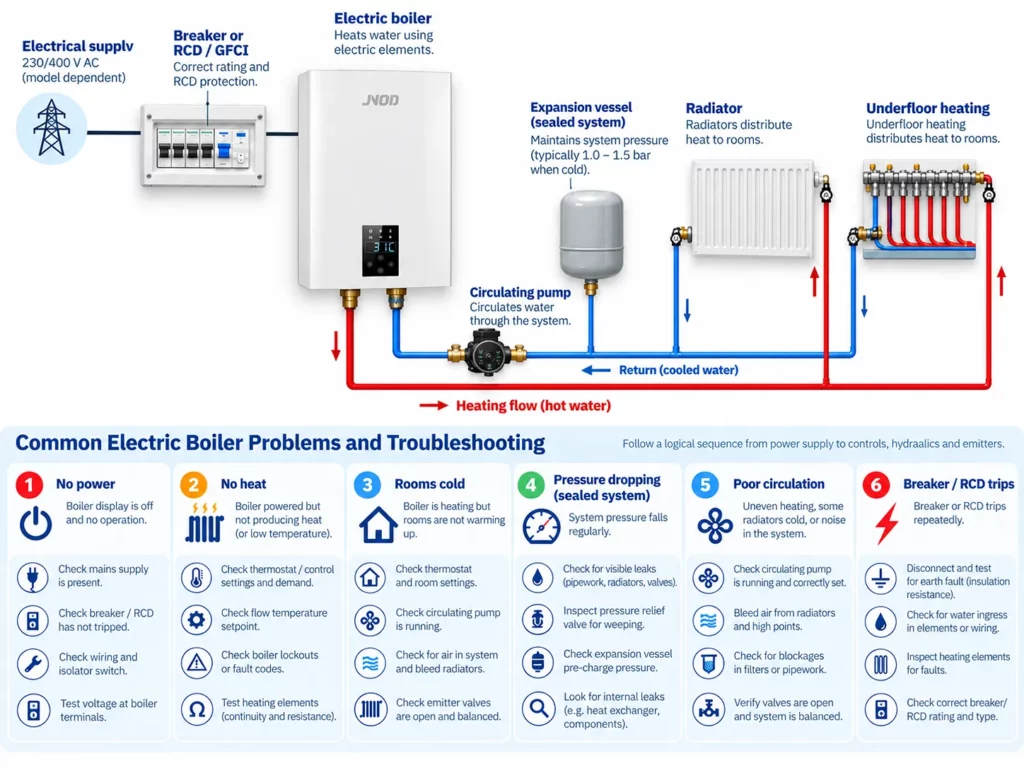
1. Electric Boiler Has No Power
If the display and controls are completely off, begin outside the boiler.
Confirm that the building supply is available and that the external isolator and protective devices are in their normal operating state.
Also check that the supply voltage and phase configuration match the boiler specification.
A blank display does not automatically mean a PCB failure. Loss of supply, an upstream protection issue, incorrect wiring, or an external control problem can produce the same symptom.
For newly installed equipment, confirm that the selected boiler output is compatible with the site’s electrical infrastructure. Higher-output electric boilers can place a substantial load on the building supply.
If electrical capacity is uncertain, the supply should be assessed before internal troubleshooting continues.
2. Electric Boiler Turns On but Does Not Heat
This is one of the most common electric boiler troubleshooting scenarios.
If the display is active but the boiler does not produce heat, first determine whether the controller is actually requesting heating.
Check:
- thermostat demand;
- operating mode;
- programmed schedule;
- target temperature;
- external controls;
- water circulation.
A boiler can be powered correctly but remain inactive because there is no valid heating demand.
If heating demand is present, the next question is whether water is circulating through the system. Poor circulation may trigger protective control logic or prevent heat from being transferred correctly.
For an unfamiliar installation, review the normal operating sequence and any active fault code before assuming that the heating element or control board has failed.
3. Boiler Is Heating but the Rooms Stay Cold
When the boiler produces heat but the building remains cold, the fault is often outside the boiler.
Start with three questions:
- Is the boiler producing enough heat for the building load?
- Is the system circulating that heat effectively?
- Can the radiators or underfloor heating emit enough heat into the rooms?
A boiler with adequate electrical output can still provide poor comfort if the flow temperature is too low, water flow is restricted, the radiators are undersized, or the system is poorly balanced.
Increasing the boiler setpoint may temporarily make rooms warmer without correcting the real hydraulic or emitter problem.
The correct electric boiler flow temperature should be considered together with design heat loss, emitter size, water flow, and hydraulic balance.
4. Electric Boiler Does Not Reach the Set Temperature
If an electric boiler runs for long periods but cannot reach the required room or water temperature, do not immediately conclude that the boiler is undersized.
First compare the boiler output with the building’s actual heating demand.
A sizing calculation based only on floor area can give misleading results. Insulation level, outdoor design temperature, windows, ventilation, air leakage, and required indoor temperature all affect heat loss.
If boiler output is uncertain, start with a proper electric boiler sizing assessment based on the building’s design heat loss rather than floor area alone.
If the boiler is correctly sized, investigate the rest of the system.
Possible causes include:
- insufficient water flow;
- low flow temperature;
- undersized radiators;
- poor hydraulic balancing;
- incorrect control settings;
- excessive building heat loss;
- circulation problems.
A useful diagnostic question is not simply:
Is the boiler running?
It is:
Where is the heat being lost between the boiler and the room?
That question usually leads to a more useful diagnosis.
5. System Pressure Keeps Dropping in a Sealed Heating System
In a sealed or pressurized heating system, repeatedly falling pressure usually points to a hydraulic issue rather than an electrical boiler fault.
If pressure falls after the system has been filled correctly, look for the cause instead of repeatedly topping up the circuit.
Possible areas to investigate include:
- visible leaks;
- pipe joints and valves;
- radiator connections;
- expansion vessel condition;
- pressure-relief components;
- trapped air released after commissioning.
The boiler pressure gauge guide explains how pressure changes between cold and operating conditions and what abnormal readings may indicate.
A single pressure reading also needs context because pressure normally changes as the system heats and cools.
Repeatedly adding water without identifying the cause does not solve the fault and may introduce additional fresh water and oxygen into the heating circuit.
Open-vented systems operate differently, so this type of pressure-loss diagnosis does not apply in the same way.
6. Pump Runs but Water Is Not Circulating Correctly
Electric boiler performance depends on adequate water flow.
If the boiler heats rapidly but the heating circuit remains cool, or if temperature rises unusually quickly before the boiler stops, inspect the hydraulic side of the system.
Possible causes include:
- closed or incorrectly positioned valves;
- air trapped in the system;
- incorrect pump operation;
- blocked strainers or restrictions;
- unsuitable pipe sizing;
- poor hydraulic balancing.
For larger or retrofit systems, proper pipe sizing is important because excessive pressure drop can reduce circulation and heating performance.
An undersized pipe can restrict flow, while an incorrectly designed circuit may prevent enough water from reaching radiators or underfloor heating loops.
The boiler, pump, pipework, and emitters should therefore be treated as one hydraulic system rather than separate components.
7. Electric Boiler Keeps Tripping the Breaker or RCD/GFCI
Repeated electrical tripping is not a normal operating condition.
A circuit breaker may trip because of overload or short-circuit current, while an RCD, GFCI, or equivalent residual-current protection device responds to current leaking to earth or ground. The protection arrangement and terminology vary by market.
Possible causes include:
- insufficient electrical capacity;
- incorrect circuit design;
- wiring faults;
- damaged electrical components;
- moisture or water ingress;
- insulation faults.
Do not repeatedly reset a protective device simply to keep the boiler running.
Protection devices operate for a reason. If tripping continues, the electrical cause should be identified by appropriately qualified personnel before the boiler returns to service.
For a more detailed explanation of electrical load and protection, see our guide to electric boiler breaker tripping.
8. Boiler Is Noisy or Heating Is Unstable
Electric boilers do not have a burner or combustion fan, so unusual noise often points toward the hydraulic system rather than combustion equipment.
Check whether the noise is associated with:
- trapped air;
- circulation pump operation;
- excessive water velocity;
- restricted flow;
- system pressure;
- rapid temperature changes.
Uneven heating can also indicate poor hydraulic balance.
For example, radiators close to the boiler may receive excessive flow while more distant emitters remain cool.
In that situation, increasing the boiler setpoint is unlikely to solve the problem. The system needs to be checked and balanced.
9. When the Problem Is Not the Boiler
Good electric boiler troubleshooting includes the possibility that the boiler is operating correctly.
Consider a system where the boiler reaches its target temperature, the heating elements operate normally, and there are no fault indications, but some rooms remain cold.
Replacing boiler components is unlikely to solve the problem.
Instead, investigate the following areas.
Boiler Sizing
Does the selected boiler output match the building’s design heat loss?
Flow Temperature
Is the water temperature suitable for the installed radiators or underfloor heating?
Water Flow
Is enough water circulating through the heating circuit?
Heat Emitters
Can the radiators or floor loops deliver the required room heat at the selected water temperature?
Hydraulic Balance
Is water distributed correctly across the system?
Controls
Are thermostats, sensors, schedules, zone valves, and external controllers requesting heat correctly?
This distinction matters for distributors as well as installers.
A system problem reported as a “boiler fault” can lead to unnecessary component replacement, repeated site visits, and avoidable warranty claims.
10. A Practical Electric Boiler Troubleshooting Sequence
Instead of checking components randomly, work from the system level toward the boiler.
Step 1 — Confirm the Symptom
Define the actual problem:
- no power;
- no heat;
- insufficient heat;
- low pressure;
- unstable temperature;
- poor circulation;
- electrical tripping.
Step 2 — Check Installation Conditions
Confirm:
- supply voltage;
- phase configuration;
- boiler output;
- heating-system type;
- basic hydraulic arrangement.
Step 3 — Check Heat Demand and Controls
Confirm that the thermostat, controller, or building-management system is actually requesting heating.
Step 4 — Check Circulation
Review system pressure, pump operation, valve position, water flow, air, and obvious restrictions.
Step 5 — Compare Boiler Operation With System Demand
Check whether boiler output, flow temperature, and heat emitters are appropriate for the building load.
Step 6 — Review Fault Information
Use the manufacturer’s fault codes, installation manual, service documentation, and commissioning records where available.
Step 7 — Escalate Electrical or Internal Faults
Before opening electrical compartments, isolate the boiler from its electrical supply according to the applicable safety procedure.
Testing that requires access to internal electrical circuits, insulation-resistance measurements, protective devices, or work on or near energized components should only be carried out by personnel qualified for that specific task.
The UK Health and Safety Executive advises that people working on electrical equipment and installations should have the necessary competence for the work they undertake. See the official HSE electrical safety guidance.
NFPA guidance also treats electrical qualification as task-specific: a qualified person needs appropriate knowledge of the equipment and associated electrical hazards. See the NFPA 70E electrical safety guidance.
When Should an Installer Stop Troubleshooting?
Not every fault should be investigated through repeated trial and error.
Stop basic troubleshooting and escalate the problem if there is:
- repeated breaker or RCD/GFCI operation;
- evidence of overheating;
- damaged wiring or connectors;
- signs of water entering electrical areas;
- suspected insulation failure;
- damaged internal electrical components;
- a fault requiring live electrical testing;
- uncertainty about safe isolation.
Do not bypass protective devices or defeat safety controls to keep the boiler operating.
A successful troubleshooting process identifies the cause safely. It does not force the boiler back into operation without understanding why protection was activated.
FAQ
Why is my electric boiler on but not heating?
First confirm that there is a heating demand from the thermostat or controller. Then check water circulation, system pressure, controls, and whether the boiler is operating within normal conditions. If diagnosis requires internal electrical testing, use suitably qualified personnel.
Why does my electric boiler keep stopping?
Possible causes include control settings, poor circulation, protection functions, incorrect system conditions, or an electrical fault. Identify the stopping condition and any fault code before resetting or replacing components.
Can low water pressure stop an electric boiler from heating?
In sealed or pressurized systems, abnormal pressure can affect safe operation depending on the boiler design. If pressure repeatedly drops, investigate the hydraulic cause instead of continually refilling the circuit.
Why is my electric boiler running but the house is still cold?
The boiler may not be the problem. Check building heat loss, boiler sizing, flow temperature, circulation, radiator or underfloor heating output, and hydraulic balancing.
What should I do if an electric boiler keeps tripping the breaker?
Do not repeatedly reset the breaker or bypass the protective device. Confirm the electrical load and installation conditions, then have a qualified electrical professional investigate repeated tripping or suspected internal electrical faults.
Conclusion
Good electric boiler troubleshooting starts by separating three areas:
Electrical supply → Boiler operation → Heating system
If the boiler has power but does not heat, check heat demand and circulation.
If the boiler produces heat but rooms remain cold, check flow temperature, hydraulic balance, emitters, and building heat loss.
If electrical protection repeatedly operates, stop treating the symptom and identify the electrical cause before returning the boiler to service.
For installers and distributors, this system-level approach reduces unnecessary component replacement and makes it easier to distinguish a product fault from an installation or design problem.
JNOD supplies electric system boilers, electric combi boilers, open-vented boilers, and commercial electric heating solutions for residential and project applications.
For technical selection or troubleshooting support, provide the boiler model, output, voltage and phase, heating-system type, fault code, system pressure, and a clear description of when the problem occurs.
Need help selecting or troubleshooting an electric boiler for your project? Contact JNOD with your boiler model, power supply, heating-system details, and fault information.