
Zero-Loss Hydronics: How Precision Electric Boilers Cut Heating Bills?
Electric boilers are no longer backup heaters for summer cabins. They are fully certified, primary heating machines for modern villas, apartments, and light commercial spaces. When gas lines are absent and district heating costs too much, electricity steps in.
Let’s kill a common myth right now: electric heating does not have to drain your wallet. High bills happen because of sloppy system design and wild temperature swings—not the fuel source itself. At JNOD, we engineer hydronic equipment to stop heat loss at the molecular and mechanical levels.
Quick Answer: Precision electric boilers cut operational bills by eliminating standby chimney losses, stopping room overheating via ±0.3°C controls, and integrating automated weather compensation.
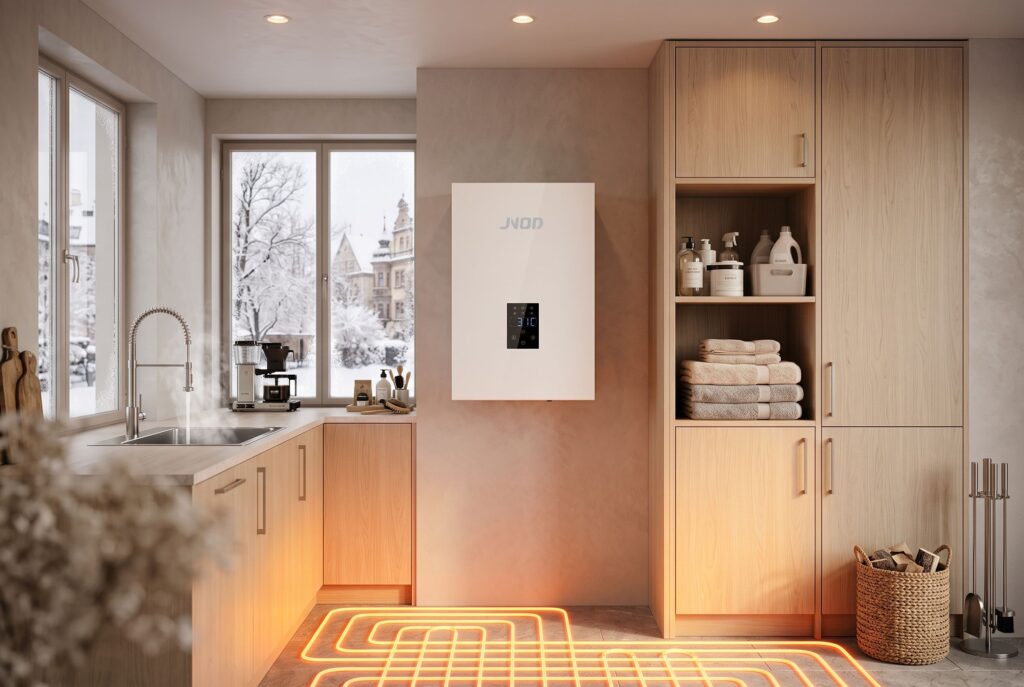
Why do traditional systems lead to higher heating bills?
Gas boilers waste energy through the flue pipe. Standard electric heaters cycle on and off constantly, creating massive thermal spikes that waste power.
We see this in field checks every winter. A boiler fires at 100% capacity, overshoots your thermostat target by 3°C, and shuts down suddenly. That extra heat escapes through walls and windows before you even feel it!
Real energy savings come from tight thermal stability. When your water flow stays within a fraction of a degree of the exact target, your heat emitters run continuously at lower, more efficient temperatures. According to comprehensive building efficiency data from the U.S. Department of Energy, reducing overheating cycles is one of the most reliable ways to slash monthly utility loads.
Analysis of Zero-Loss Hydraulic Systems: JNOD Engineering Solutions
We took apart standard heating element architecture and rebuilt it from scratch.
Patented Dry Heating Elements
Water and electricity must never meet. Our heating elements use a physical isolation barrier that separates current-carrying conductors from the hydronic fluid.
This design prevents internal scale accumulation on electrical contacts. Scale acts as an unwanted thermal insulator, forcing traditional elements to draw more amperage just to deliver baseline output. With JNOD, heat transfer remains instantaneous year after year.
Dynamic CNAS-Tested Auto-Adjustment
Standard units guess your heat demand. JNOD units calculate it in real time.
In our certified CNAS laboratory testing, our BO series kept temperature fluctuations within a razor-thin ±0.3°C margin, even when thermal loads shifted by 40%. That means no overshoot. No wasted kilowatt-hours. Just clean, steady warmth.
How to Choose Your Boiler Setup: Sizing and Configuration
Selecting the right boiler requires answering three practical questions.
| System Factor | Direct Dual-Circuit (Combi Boiler) | Single-Circuit + Indirect Tank (System Boiler) | Open-Vented Boiler |
| Best For | Apartments & compact homes | Large villas & multi-bath suites | Old homes & cast-iron loops |
| Recommended Model | JNOD BP-E / BW-E Series | JNOD BT Series | JNOD BQ Series |
| DHW Performance | Instant on-demand | High-volume storage | Limited flow |
| System Pressure | 0.5 – 3.0 Bar (Closed) | 0.5 – 3.0 Bar (Closed) | Atmospheric (0 Bar) |
| Typical Efficiency | Up to 99% | Up to 99% | 92 – 95% |
1. Do You Need Domestic Hot Water (DHW)?
If space is tight, choose a dual-circuit combi boiler. It warms your hydronic floors and feeds your faucets from one chassis.
Got two showers running at the same time? Pair our JNOD BT single-circuit boiler with an indirect storage cylinder instead. This setup handles heavy peak-hour hot water demands without dropping your room heating loops.
2. Closed Loop or Open Gravity?
Closed, pressurized systems are the modern standard. Units like the JNOD BO-E mount cleanly on utility room walls, prevent oxygen entry, and keep system pressures stable.
3. Electrical Load Sizing
Never guess your cable gauge! An 80 m² well-insulated home usually needs an 8–10 kW unit.
A 10 kW load demands a dedicated 6 mm² copper line and a 50A circuit breaker. Never plug an electric boiler into a common wall socket—it violates international safety codes under standards set by the International Electrotechnical Commission (IEC) and will melt your terminals.
Field Installation: Avoid These Costly Contractor Mistakes
Great hardware fails if the installation is sloppy. We see simple field mistakes turn high-efficiency systems into service nightmares.
- Mount strictly vertical: Tilting trips internal fluid level sensors and locks out heating cycles immediately.
- Install a Y-strainer on the return line: Rust particles and installation debris ruin circulating pump impellers.
- Verify grounding resistance: Keep earth resistance below 4 Ω to prevent induced voltage from false tripping your residual-current device (RCD).
- Protect the user interface: Keep touch displays, like the tempered glass panel on the JNOD BX-E, away from direct water sprays.
FAQ
Can an electric boiler heat an entire house in freezing weather?
How much can smart controls reduce my monthly power bill?
Do I need a three-phase power supply?
Conclusion
Electric boilers are no longer expensive to operate when engineered with precision auto-adjustment and zero standby losses. They deliver silent, zero-emission comfort while eliminating chimney flues and gas maintenance checks.
Explore our full line of commercial and residential hydronic heating systems, request engineering data sheets, or connect with our OEM/ODM manufacturing team today.