
What Makes a Good Electric Boiler? Key Safety Features & Smart Functions
Quick Answer
Understanding modern electric boiler functions helps homeowners and engineers choose a system that combines active hardware protection with smart energy management.
It should protect itself against freezing, pump failure, dry-firing, and electrical surges—all without manual intervention. At JNOD, we engineer our electric boilers with dual-stage thermal safeguards and flexible Tuya-driven IoT controls to deliver steady hydronic heating at minimal operational cost.
Why Cheap Boilers Fail?
Most electric boiler breakdowns happen when nobody is watching.
A sudden winter cold snap freezes idle radiant pipes, or a pump seizes after sitting dormant all summer. When an unmonitored heating element boils dry without water, the hardware burns out in seconds.
Why should a homeowner or facility manager worry about system oversight?
A heating system must manage its own survival. That is why at JNOD, we treat autonomous safety systems as essential electric boiler functions
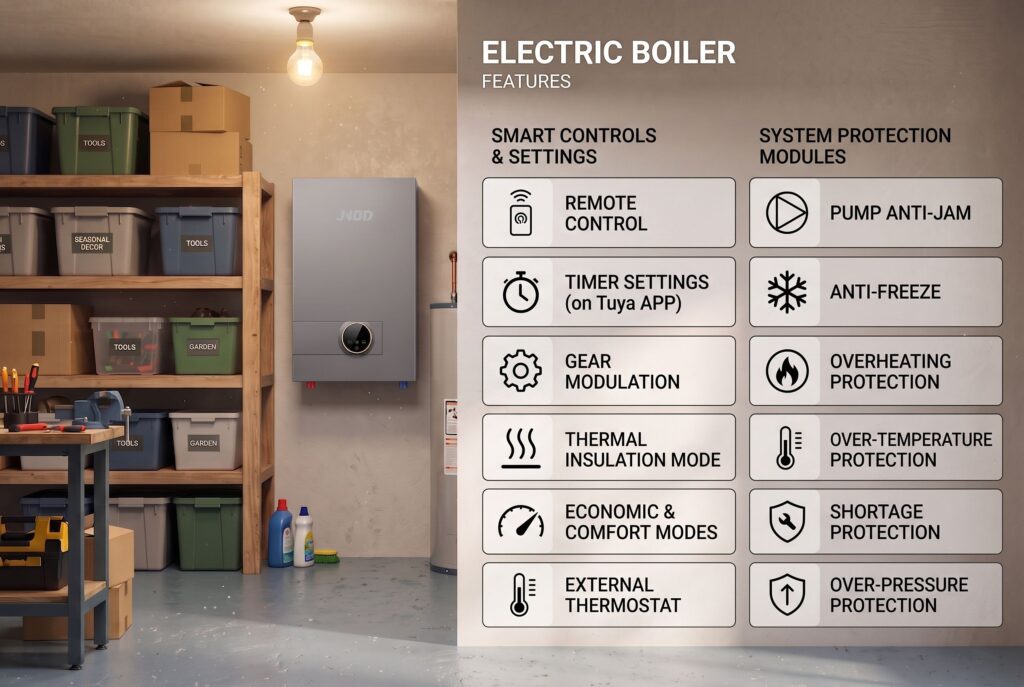
Essential Safety Systems Built into the JNOD Platform
Modern hydronic loops face unpredictable operating conditions.
We programmed our firmware to respond instantly to hydraulic and electrical anomalies before they cause physical damage.
1. 2-Stage Intelligent Anti-Freeze Protection
Water expands when it freezes, cracking expensive underfloor piping.
Our controller constantly tracks real-time loop temperature via high-precision NTC thermistors. When the probe reads ≤ 8°C, the boiler engages Stage 1 anti-freeze, circulating water through the circuit to prevent cold spots. If line temperatures drop further to ≤ 5°C, Stage 2 triggers automatically, firing the heating elements to bring the loop safely back above freezing thresholds.
2. Automatic Pump Anti-Seize Cycling
Circulation pumps hate long periods of inactivity.
During warm seasons, scale and sediment settle inside the impeller housing, locking the motor when winter arrives. If our system detects that the internal pump has been idle for 18 consecutive hours, it runs the pump for 60 seconds automatically. This quick cycle keeps mechanical seals lubricated and prevents costly service callouts.
3. Dual Thermal Defense: Overheating & Over-Temperature Safeguards
Temperature spikes shorten equipment lifespan.
We split our thermal protection into return-water and supply-water monitoring paths. When the return water sensor detects temperatures above 60°C, the boiler cuts power and shifts into thermal insulation hold until the water cools back down below 60°C.
For the outlet flow, heating stops immediately if the supply probe reaches ≥ 80°C. If thermal runaway pushes the water to ≥ 95°C , the system triggers the E3 lock code, re-engaging only after the water cools back to a safe 80°C.
4. Dry-Fire Prevention: Low Water Pressure Protection
Heating without water destroys electric elements within minutes.
Our digital pressure sensors track system volume around the clock. If loop pressure falls below minimum operational thresholds, the controller cuts off heating immediately and flashes the E0 error code to lock operation until the loop is refilled.
Guidelines from the Chartered Institution of Building Services Engineers (CIBSE) confirm that closed-loop pressure monitoring is essential for preventing cavitation and element burnout in modern hydronic heating systems.
5. Over-Voltage Grid Defense
Unstable power grids damage sensitive control boards.
If the electrical input spikes to ≥ 300 V, the board trips safety isolation, shuts down heating, and logs the EA error code. This protects the solid-state relays and microchips from high-voltage surges.
Smart Electric Boiler Functions: Cutting Power Draw Without Sacrificing Comfort
Safety keeps the unit running, but intelligent controls keep utility bills low.
Electricity is a premium fuel source. A great electric boiler must optimize every kilowatt-hour.
The JNOD Energy Management Center architecture is based on three core technologies:
IoT Control: Tuya App Wi-Fi, customizable 7-day/weekly schedules, and dedicated dry contacts for connecting external thermostats.
Three-Level Dynamic Power Control: P1 (33% partial load), P2 (66% medium load), and P3 (100% full load).
Dual Comfort and Energy-Saving Modes: Energy-saving mode tracks supply water temperature to conserve energy, while comfort mode monitors return water temperature to ensure stable radiant heating and features automatic heat preservation to prevent system overheating.
Wi-Fi Remote Access & 7-Day Tuya Scheduling
You should never have to manually adjust boiler dials in a cold basement.
With an integrated Wi-Fi module, users sync the boiler to the Tuya Smart platform in seconds. You can set granular weekly on/off schedules right from your smartphone, heating the home only during off-peak electricity hours.
3-Stage Dynamic Power Output (P1 / P2 / P3)
Full power is rarely needed during mild autumn or spring days.
These energy-saving electric boiler functions allow operators to cap peak power output across three distinct tiers:
- P1 Mode (33% Power): Perfect for mild weather, single-room zones, or limited electrical service panels.
- P2 Mode (66% Power): Balanced daily operation for steady, mid-season comfort.
- P3 Mode (100% Power): Full-throttle heating capacity for deep winter cold spells and high DHW demand.
Dual Operating Modes: Eco vs. Comfort
Different homes need different control logic.
In Eco Mode, the unit monitors supply water temperature to maintain target heat with minimal cycling—ideal for well-insulated properties. In Comfort Mode, the system measures return water temperature, ensuring dense radiant floor slabs absorb consistent thermal energy.
The Building Research Establishment (BRE) emphasizes that responsive zoning and return-temperature tracking significantly improve seasonal performance factors in electric wet central heating.
External Thermostat Interface
Prefer your existing smart home thermostat?
Every JNOD boiler includes dedicated dry-contact terminals on the main motherboard. Installers can easily wire external room thermostats, letting your preferred wall interface control heating cycles seamlessly.
Comparison: JNOD Electric Boiler Functions vs. Basic Electric Boilers
| Operating Feature | JNOD Smart Electric Boiler | Basic Entry-Level Electric Boiler |
| Freeze Protection | 2-Stage Logic (8°C Circulate / 5°C Fire) | Single basic thermostat trigger or none |
| Pump Maintenance | Auto Anti-Seize (1-min run every 18h) | None (Manual seasonal unsticking needed) |
| Output Regulation | 3-Tier Modulation (33% / 66% / 100%) | 100% On/Off switching only |
| Low-Water Safety | Active Sensor Lock (E0 Code) | Basic mechanical pressure switch |
| Grid Voltage Protection | 300V Surge Lock (EA Code) | Standard fuse only |
| Cloud Connectivity | Tuya Wi-Fi + 7-Day Cycle Timers | Local manual dial only |
| Thermostat Compatibility | Integrated External Interface | Proprietary or incompatible |
FAQ
Which electric boiler functions are most important for winter reliability?
The 2-stage freeze protection and 18-hour pump anti-seize cycle are critical. They protect hydraulic circuits from burst pipes and frozen impellers during sub-zero temperatures.
What should I do if my boiler displays error code E0?
Error code E0 indicates low system water pressure. Check your external pressure gauge, use your filling loop to repressurize the system to 1.0–1.5 bar, and the boiler will automatically clear the code.
Does the boiler consume high power while running in anti-freeze mode?
No. Stage 1 only runs the circulation pump to move residual heat around the loop. The heating elements only draw power if loop water falls below 5°C in Stage 2.
Can I connect the boiler to third-party home automation systems?
Yes. The open dry-contact terminal links easily with third-party thermostats, and the onboard Tuya chip pairs seamlessly with Google Home and Amazon Alexa ecosystems.
Conclusion
A great electric boiler is defined by how quietly and reliably it protects itself.
By combining autonomous anti-seize routines, multi-stage freeze defense, clear error codes, and smart electric boiler functions
Partner with JNOD for OEM & Commercial Heating Solutions
Looking to expand your hydronic heating lineup with robust, smart-connected electric combi boilers?
JNOD designs and manufactures high-efficiency electric boilers, heat pump systems, and intelligent thermal controllers for global distributors, MEP contractors, and OEM brands.
[Contact the JNOD Engineering Team] to request detailed wiring schematics, technical submittals, and wholesale OEM pricing.