
Electric Boiler Flow Temperature: A Guide for Radiators and Underfloor Heating
Electric boiler flow temperature is the temperature of the heating water leaving the boiler and entering the heating circuit.
The right setting depends on building heat loss, heat emitters, outdoor conditions, and the required indoor temperature. Radiators and underfloor heating normally operate at different flow temperatures.
For installers, the aim is not to use the highest available temperature. It is to use the lowest practical flow temperature that allows the heat emitters to meet the required room temperature under the design conditions.
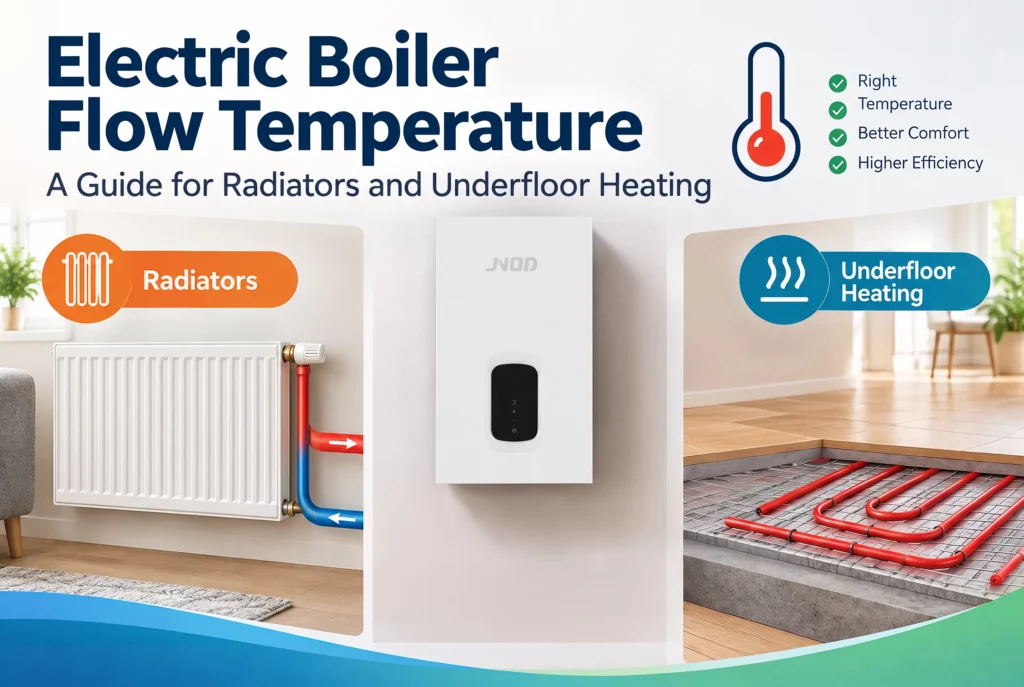
Quick Answer: What Temperature Should an Electric Boiler Be Set At?
There is no single flow temperature that suits every heating system.
As a general starting point:
| Heating system | Typical starting range |
|---|---|
| Underfloor heating | Around 30–45°C |
| Low-temperature radiators | Around 40–55°C |
| Conventional radiators | Around 55–70°C |
| Older or high-heat-loss systems | May require higher temperatures |
These are typical starting ranges, not universal set points. The actual design temperature depends on heat loss, emitter output, system design, controls, and outdoor conditions.
For final system design, use the lowest practical flow temperature at which the heat emitters can meet the required room temperature at the project’s design outdoor condition.
For reference, JNOD electric system boilers specify 30–80°C for radiator operation and 30–60°C for floor-heating operation, with a maximum water temperature of 85°C. The exact range varies by product series.
What Is Electric Boiler Flow Temperature?
Flow temperature is the temperature of the heating water as it leaves the boiler and enters the heating circuit.
It is different from:
- Room temperature
- Thermostat setpoint
- Return temperature
- Boiler output in kW
For example, a room thermostat may be set to 21°C while the heating circuit operates at 50°C.
The boiler heats the water. The radiators or underfloor pipes then transfer that heat to the building.
This means flow temperature should always be considered together with the heat emitters and the rest of the hydronic system.
What Determines the Correct Flow Temperature?
Four factors are especially important.
Building Heat Loss
A building with higher heat loss needs more heat from its emitters. Flow temperature therefore needs to be selected after the heating load is understood.
Our guide to electric boiler sizing explains how heat loss, insulation, outdoor temperature, and heating system requirements affect boiler selection.
Heat Emitters
Radiators and underfloor heating transfer heat differently.
A large floor area can deliver the required room heat at a lower water temperature. A smaller radiator may need hotter water to provide the same output.
Building Condition
Insulation, windows, ventilation, air leakage, and outdoor temperature all affect the amount of heat the building loses.
System Design
Radiator size, underfloor pipe spacing, water flow, hydraulic balance, pipework, and controls also affect heat transfer.
The CIBSE Domestic Heating Design Guide 2026 updates guidance on heat-loss assessment, weather data, controls, domestic hot water, hydraulic design, and low-temperature heating systems.
Electric Boiler Flow Temperature for Radiators
Radiator systems generally operate at a higher flow temperature than underfloor heating.
The required temperature depends on radiator size, room heat loss, flow rate, and the temperature difference between the radiator and the room.
A larger radiator can provide the required heat at a lower flow temperature. A smaller radiator may need hotter water.
This is especially important in retrofit projects.
For example, an older building may have radiators designed around relatively high-temperature operation. If the installer lowers the flow temperature without checking radiator output, some rooms may no longer reach the required indoor temperature.
The practical sequence is:
Heat loss → Radiator output → Required flow temperature
Do not select the flow temperature first and assume the existing radiators will provide enough heat.
For hydronic radiator applications, JNOD electric system boilers are available in different output and temperature configurations.
Electric Boiler Flow Temperature for Underfloor Heating
Underfloor heating normally uses a lower flow temperature because the floor provides a large heat-emitting surface.
A typical starting range is around 30–45°C, but the final design depends on:
- Floor construction
- Pipe spacing
- Insulation
- Floor covering
- Required heat output
- Room temperature
- Building heat loss
A lower flow temperature does not mean the building needs fewer kilowatts.
For example, a building can still have a 12 kW design heat load. A larger floor-heating emitter area simply allows that heat to be delivered at a lower water temperature.
JNOD’s BO series electric system boilers are designed for radiator and floor-heating applications. The BO Series specifies 30–80°C for radiator operation and 30–55°C for floor-heating operation.
Does Lower Flow Temperature Reduce Electricity Consumption?
It can reduce some system heat losses, but an electric resistance boiler works differently from a condensing gas boiler.
An electric resistance heater converts electrical energy directly into heat. U.S. Department of Energy technical guidance describes electric resistance heating as 100% efficient at the point of use, with an effective COP of 1. DOE technical guidance on electric resistance heating explains this relationship.
Therefore:
Lowering flow temperature does not increase the electrical-to-heat conversion efficiency of a resistance boiler.
This is different from a condensing gas boiler, where lower return temperatures can support condensing operation.
However, lower practical flow temperatures can still benefit the overall heating system. They can:
- Reduce heat losses from hot distribution pipework
- Avoid unnecessary high-temperature operation
- Work well with larger or low-temperature heat emitters
- Support more responsive heating control
Whether total electricity use falls depends on the complete system, including emitter performance, distribution losses, controls, building heat loss, and operating conditions.
The target should not be “as low as possible.”
It should be:
“As low as practical while still meeting the required room temperature.”
What Happens If the Flow Temperature Is Too High?
An unnecessarily high flow temperature can create several problems.
Higher Distribution Losses
Hotter water can increase heat loss from pipes, valves, and other components, particularly where distribution pipe insulation is limited.
Poor Matching With Low-Temperature Systems
Underfloor heating is normally designed for lower water temperatures. A much higher boiler temperature may require additional mixing and control arrangements.
Unnecessary High-Temperature Operation
A boiler does not need to operate at its maximum temperature simply because that temperature is available.
The flow temperature should match the heating circuit and emitter design.
What Happens If the Flow Temperature Is Too Low?
A flow temperature that is too low can also cause problems.
The most obvious sign is:
The rooms do not reach the required temperature.
Other signs may include:
- Radiators remain warm but provide insufficient output
- Heating recovery takes too long
- Some rooms reach temperature while others stay cold
- The boiler runs for long periods
When this happens, do not immediately assume that the boiler needs more kW.
Check the radiator or underfloor heating design, flow rate, hydraulic balance, insulation, controls, and building heat loss first.
A heating problem is not always a boiler-capacity problem.
Flow Temperature vs Boiler Output
Flow temperature and boiler output are related, but they are not the same.
Boiler output = how much heat the boiler can produce
Flow temperature = how hot the heating water is during operation
For example, a 15 kW electric boiler can operate at different flow temperatures depending on the heating system.
Changing the flow temperature does not automatically change the building’s design heat load. Instead, it affects how the heat emitters transfer the available heat to the rooms.
The design sequence is:
Heat Loss → Boiler Output → Heat Emitter → Flow Temperature → Controls
This distinction is important when selecting and commissioning an electric boiler.
How Outdoor Temperature Affects Flow Temperature
The required flow temperature can change as outdoor conditions change.
When outdoor temperatures are mild, the building normally loses less heat. A lower water temperature may therefore be enough.
When outdoor temperatures fall, heat loss increases and the heating system may need a higher flow temperature.
This is the principle behind weather compensation.
Instead of keeping the heating water at one fixed temperature throughout the heating season, a weather-compensated control system adjusts the target according to outdoor conditions and the selected heating curve.
This can help avoid unnecessarily high water temperatures during milder weather.
Selected JNOD electric boiler systems support smart control functions, including Wi-Fi control and thermostat interfaces. See our guide to electric boiler smart controls and safety functions for more information.
How Should Installers Set the Flow Temperature?
A practical commissioning process is:
1. Check the design heat loss
Know the building’s heating requirement.
2. Identify the heat emitters
Confirm whether the system uses radiators, underfloor heating, or mixed circuits.
3. Check emitter capacity
Make sure the emitters can deliver the required heat at the selected temperature.
4. Set an appropriate initial temperature
Avoid using the maximum boiler setting unless the system requires it.
5. Check room performance and controls
Confirm that the design rooms reach the required indoor temperature, then adjust the setpoint or heating curve as needed.
If rooms still do not reach the required temperature, check flow rate, hydraulic balance, air in the system, pump operation, emitter sizing, insulation, and controls before simply increasing the boiler temperature.
The final setting should come from the system design and commissioning results, not from a single temperature copied from another installation.
Does Domestic Hot Water Need a Higher Temperature?
Space heating and domestic hot water can have different temperature requirements.
Radiators and underfloor heating may operate at relatively low temperatures, while domestic hot water storage may require a higher temperature depending on the system design and applicable safety requirements.
For compact residential applications, an electric combi boiler can combine space heating and domestic hot water in one system.
The important point is to avoid using an unnecessarily high space-heating flow temperature simply because the DHW system has different requirements.
Common Electric Boiler Flow Temperature Mistakes
Using the Maximum Temperature by Default
The highest available temperature is not automatically the correct setting.
Using the Same Temperature for Every Heating System
Radiators and underfloor heating have different heat-emitter characteristics.
Ignoring Existing Radiators
Lowering flow temperature in a retrofit can reduce radiator output if the emitters were designed for higher-temperature operation.
Confusing Boiler Output With Flow Temperature
A lower flow temperature does not automatically mean the building needs a smaller boiler.
Adjusting Temperature Without Checking the System
Low flow, poor hydraulic balance, air, undersized emitters, or incorrect controls can all affect room temperature.
Electric Boiler Flow Temperature Checklist
Before finalising the setting, installers should check:
Building
- Design heat loss
- Outdoor design temperature
- Insulation level
Heating system
- Radiators or underfloor heating
- Emitter size
- Required room temperature
- Pipework and flow rate
Boiler
- Available flow-temperature range
- Maximum water temperature
- Output capacity
- Control functions
Controls
- Room thermostat
- Heating curve
- Weather compensation
- Scheduling
Domestic hot water
- Storage or instantaneous DHW
- Required DHW temperature
- Separate DHW control where applicable
FAQ
What is the best flow temperature for an electric boiler?
There is no single best setting. The correct flow temperature depends on building heat loss, heat emitters, outdoor conditions, system design, and the required indoor temperature.
What flow temperature should an electric boiler use for radiators?
Radiator systems often require higher temperatures than underfloor heating. The actual setting depends on radiator size, building heat loss, flow rate, and system design.
What flow temperature should an electric boiler use for underfloor heating?
Underfloor heating commonly operates in a lower temperature range, often around 30–45°C. The final design temperature depends on floor construction, pipe spacing, insulation, surface finish, and heat demand.
Does lowering electric boiler flow temperature save electricity?
It can reduce some distribution and system heat losses, but it does not increase the point-of-use electrical conversion efficiency of an electric resistance boiler. The temperature should be low enough for suitable system operation while still meeting the building’s heat demand.
Does flow temperature affect electric boiler sizing?
Flow temperature affects heat-emitter output, but it does not replace the building heat-loss calculation. Boiler sizing and flow-temperature selection are connected but separate design steps.
conclusion
Electric boiler flow temperature should be selected as part of the complete heating system.
Start with the building heat loss. Then check the heat emitters, required room temperature, outdoor conditions, hydraulic system, controls, and domestic hot water requirements.
Radiators may need higher temperatures, while underfloor heating normally works at lower temperatures.
The goal is not to run the boiler as hot as possible.
The goal is to use the right flow temperature for the heating system and the building.
Need Help Selecting the Right Electric Boiler?
For project enquiries, send JNOD:
- Calculated heat load or heating area
- Heating system type
- Required flow temperature
- Local outdoor design temperature
- Voltage and phase
- DHW requirements
- Target market
- Estimated order quantity
- OEM/ODM requirements
Our team can help evaluate the suitable boiler output, configuration, and operating temperature for the application.
Talk to JNOD about your electric boiler project.