
How Does an Electric Boiler Work?
How does an electric boiler work? An electric boiler heats water using electricity and circulates the hot water through a hydronic heating system.
The basic process is:
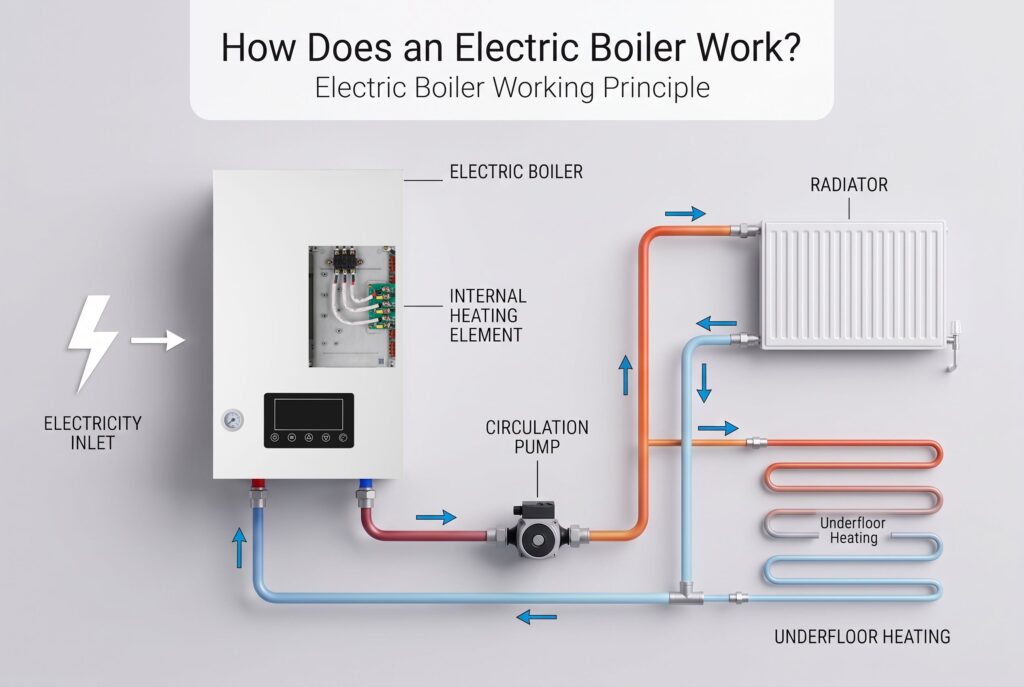
Electricity → Heating Element → Hot Water → Circulation → Radiators or Underfloor Heating
Unlike a gas boiler, an electric boiler does not burn fuel. It does not need a gas burner, combustion chamber, or combustion flue.
But the boiler is only one part of the heating system. Electrical supply, heating output, water circulation, controls, and system design all affect the final heating performance.
At JNOD, we manufacture electric boilers for residential heating, domestic hot water, and commercial applications. In this guide, I will explain how an electric boiler works and what installers, distributors, and heating professionals should consider when selecting one.
Quick Answer: How Does an Electric Boiler Work?
An electric boiler uses electrical resistance to generate heat.
When electricity enters the boiler, the heating element converts electrical energy into heat. The heat is transferred to the water, and a circulation pump moves the heated water through radiators or underfloor heating pipes.
When the water reaches the target temperature, the control system reduces or stops the heating output. When the temperature falls, the boiler starts heating again.
In simple terms:
Electricity → Heating → Water → Circulation → Heat Release → Return Water
This cycle repeats to maintain the required indoor temperature.
How Does an Electric Boiler Work Step by Step?
To understand how an electric boiler works, it helps to look at each stage of the heating process.
1. Electricity Enters the Boiler
The process starts when electrical power enters the boiler.
Depending on the model and output, an electric boiler may use a single-phase or three-phase electrical supply. Smaller residential boilers can often operate on single-phase power, while higher-output models may require three-phase power.
For example, a 12 kW boiler operating at 230 V would draw approximately 52 A under ideal conditions. This is why electrical capacity must be considered before installation.
For installers and engineers, the important points include:
- Rated power
- Supply voltage
- Single-phase or three-phase connection
- Rated current
- Breaker capacity
- Cable size
- Total electrical load
- Local electrical requirements
For a more detailed comparison, see our guide to [Single-Phase and Three-Phase Electric Boilers].
The correct electrical configuration is important for both safety and reliable operation.
2. The Heating Element Generates Heat
Inside the boiler, the heating element is responsible for generating heat.
When electrical current passes through the resistive heating element, electrical energy is converted into thermal energy. The heat is then transferred to the surrounding water.
The heating element is one of the most important components of an electric boiler. Its material, heat-transfer design, insulation, and protection system can influence durability and performance.
At JNOD, we use a cast aluminum heating element design in selected electric boiler models. The structure is designed to provide efficient heat transfer while supporting long-term operation.
If you want to understand the technology in more detail, see our guide to [Electric Boiler Heating Element Technology].
3. Water Absorbs the Heat
Once the heating element generates heat, the water inside the heating circuit absorbs it.
Temperature sensors monitor the water temperature and send information to the control system.
The controller compares the actual temperature with the target temperature and adjusts the heating operation accordingly.
For example, a radiator heating system may require a higher water temperature than a low-temperature underfloor heating system.
This is one reason why the boiler should be selected together with the heating system rather than considered as an independent product.
4. The Circulation Pump Moves Hot Water
After the water is heated, it needs to move through the heating system.
A circulation pump pushes the hot water from the boiler toward the heat emitters. The water then transfers heat into the building before returning to the boiler.
A typical hydronic heating loop looks like this:
Electric Boiler → Pump → Radiators / Underfloor Heating → Return Pipe → Electric Boiler
Many modern closed-system electric boilers integrate the circulation pump and expansion vessel into the boiler.
For example, JNOD [JNOD Electric System Boiler] are designed with integrated hydraulic components for closed hydronic heating applications.
For open-vented systems, the installation may use external components such as a pump and expansion tank. The correct configuration depends on the heating system and local installation requirements.
5. Heat Is Delivered to the Room
The hot water then reaches the heat emitters.
These may include:
- Radiators
- Underfloor heating
- Fan coil units
- Other hydronic heat emitters
The water transfers heat to the emitter, and the emitter releases that heat into the room.
This means the final heating performance does not depend only on the boiler.
Pipe sizing, flow rate, emitter selection, insulation, hydraulic balancing, and room heat loss can all affect the actual heating result.
6. Cooler Water Returns to the Boiler
After releasing heat, the water becomes cooler.
The return water flows back to the boiler, where it is heated again.
This creates a continuous closed-loop process:
Heat → Circulate → Transfer → Return → Reheat
A properly designed hydronic system should maintain sufficient flow and stable temperature control throughout this cycle.
A high-quality boiler cannot compensate for poor hydraulic design. The boiler, pipes, pump, valves, and heat emitters must work together.
What Are the Main Components of an Electric Boiler?
Although electric boilers have different designs, most modern systems include several key components.
| Component | Main Function |
|---|---|
| Heating element | Converts electrical energy into heat |
| Temperature sensor | Monitors water temperature |
| Control board | Controls heating and safety functions |
| Circulation pump | Moves water through the heating circuit |
| Expansion vessel | Manages water expansion in closed systems |
| Safety protection | Protects against abnormal temperature or pressure conditions |
| User controller | Allows users or installers to adjust operating parameters |
The exact configuration depends on the boiler type.
For example, a system boiler is designed primarily for closed hydronic heating, while a combi boiler can combine space heating and domestic hot water in one unit.
How Does an Electric Boiler Work With Radiators?
Electric boilers can work with conventional hydronic radiators.
The operating principle is straightforward:
Boiler → Hot Water → Radiator → Heat Transfer → Return Water → Boiler
The boiler heats the water, the circulation pump moves it to the radiators, and the radiators transfer heat into the room.
However, selecting the correct boiler output is important.
The required output should not be determined by floor area alone. Building insulation, outdoor temperature, room temperature, windows, building structure, and heat loss all affect the actual heating requirement.
For installers and distributors, correct sizing can help prevent both underpowered and unnecessarily oversized systems.
How Does an Electric Boiler Work With Underfloor Heating?
Electric boilers can also supply hydronic underfloor heating systems.
Underfloor heating typically operates with lower water temperatures than many traditional radiator systems. The heated water circulates through pipes installed beneath the floor and transfers heat across a large surface area.
A typical system looks like:
Electric Boiler → Mixing / Distribution System → Floor Heating Pipes → Return → Boiler
Flow temperature, pipe spacing, hydraulic balancing, and control strategy all influence performance.
If you want to understand the complete heating process, see our guide to [How Does Underfloor Heating Work?].
How Does an Electric Combi Boiler Work?
An electric combi boiler combines space heating and domestic hot water functions in one system.
Instead of using a separate heating boiler and hot water system, a combi design can provide both functions from one compact unit.
The basic principle is:
Electricity → Heating Element → Water → Heating Circuit / Domestic Hot Water
For homes with limited installation space, this configuration can be attractive because fewer separate components may be required.
JNOD electric combi boilers are designed for both room heating and domestic hot water applications, with configurations available for different power requirements and installation conditions.
Learn more about our [JNOD Electric Combi Boiler] range.
However, a combi boiler is not always the best solution for every application. Buildings with high domestic hot water demand may benefit from a system boiler combined with a separate hot water cylinder.
The right choice depends on the building, water demand, available space, and local installation requirements.
Electric Boiler vs. Gas Boiler: What Is the Difference?
The main difference is how the boiler generates heat.
| Feature | Electric Boiler | Gas Boiler |
|---|---|---|
| Energy source | Electricity | Natural gas or LPG |
| Heat generation | Electrical resistance | Fuel combustion |
| Combustion | No | Yes |
| Gas connection | Not required | Required |
| Combustion flue | Not required | Required |
An electric boiler generates heat directly through electrical resistance, while a gas boiler generates heat through combustion.
Because there is no combustion, an electric boiler does not require a gas connection or combustion flue. This can provide more flexibility for some installation projects.
However, operating cost depends on local electricity and gas prices, building heat loss, system design, and energy demand.
Are Electric Boilers Energy Efficient?
Electric resistance boilers can convert a very high proportion of the electricity they consume into heat at the point of use.
However, high conversion efficiency does not necessarily mean the lowest heating cost.
An electric boiler directly converts electricity into heat. A heat pump works differently by using electricity to move heat from the air or ground into the building.
Therefore, heating cost depends on more than the boiler’s conversion efficiency.
Electricity prices, building insulation, outdoor temperature, heating demand, system design, and the local energy mix can all affect operating costs.
For European markets, electric resistance boilers are also covered by the EU Ecodesign framework for space heaters. Requirements vary depending on the product type and application.
For regulatory information, see the European Commission’s [European Commission – Space Heaters].
Does an Electric Boiler Need a Chimney?
No.
An electric boiler does not burn gas, oil, or another fuel. Therefore, it does not produce combustion gases that require a traditional boiler flue or chimney.
This can simplify installation because there is no need to design a combustion exhaust route.
However, an electric boiler still requires:
- Correct electrical supply
- Appropriate circuit protection
- Suitable wiring
- Proper water connections
- Correct hydraulic design
- Required safety devices
- Compliance with local regulations
So, no chimney does not mean no installation requirements.
What Electrical Supply Does an Electric Boiler Need?
The electrical supply depends on the boiler’s rated power.
Common configurations include:
- 230 V single-phase
- 400 V three-phase
- Different power ratings depending on the model
For example, a 12 kW electric boiler at 230 V can draw around 52 A.
This is why installers should check the electrical system before selecting the boiler.
For higher-power applications, three-phase power can be more practical because the electrical load is distributed across multiple phases.
The final selection should always consider the actual building supply, local electrical standards, cable requirements, circuit protection, and total site load.
What Can Affect Electric Boiler Performance?
The boiler itself is only one part of the heating system.
Several factors can influence actual performance.
Incorrect Boiler Sizing
If the boiler output is too low, it may struggle to maintain the required indoor temperature.
If the boiler is significantly oversized, the system may cycle more frequently than necessary.
Boiler selection should therefore start with the building’s heating requirement.
See our guide to [What Size Electric Boiler Do I Need?] for more information.
Poor Water Circulation
Insufficient flow can reduce heat transfer and create uneven heating.
Pump selection, pipe sizing, valves, system pressure, and hydraulic balancing should all be considered.
Hard Water and Scale
Water quality can also affect heating components.
In areas with hard water, mineral deposits may accumulate on heating surfaces over time. This can affect heat transfer and increase maintenance requirements.
Read our guide to [How Hard Water Affects Your Electric Boiler] to understand the potential impact of water quality.
Building Heat Loss
Even a properly selected boiler cannot overcome excessive heat loss caused by poor insulation, inefficient windows, or other building envelope problems.
For this reason, heating system design should consider the complete building rather than the boiler alone.
What Should Distributors Check Before Buying Electric Boilers?
For Business buyers, selecting an electric boiler is different from choosing a product for a home.
Distributors, installers, and contractors should evaluate several areas before placing an order.
1. Product Configuration
Determine whether the market requires:
- Electric system boilers
- Electric combi boilers
- Open-vented electric boilers
- Electric boilers with water tanks
- Commercial electric boilers
- Customized OEM/ODM models
2. Electrical Configuration
Check:
- Power range
- Voltage
- Phase
- Rated current
- Local electrical requirements
3. Heating System Compatibility
Confirm whether the boiler will be used with:
- Radiators
- Underfloor heating
- Domestic hot water cylinders
- Existing hydronic systems
- New heating projects
4. Safety and Control Functions
Important functions may include:
- Overheat protection
- Anti-freeze protection
- Pressure protection
- Temperature control
- Fault indication
- Weather compensation
- Smart control
5. Manufacturer Support
For distributors and OEM buyers, the manufacturer matters as much as the product.
Before placing an order, I recommend checking:
- Technical documentation
- Installation manuals
- Wiring diagrams
- Spare parts availability
- Product certifications
- Packaging options
- Private-label capability
- OEM/ODM support
- After-sales technical support
JNOD provides [electric boiler manufacturing and OEM solutions] for distributors, installers, contractors, and heating-system businesses looking for long-term supply partnerships.
What About Commercial Electric Boiler Applications?
The same basic working principle applies to commercial systems, but the design requirements are usually more demanding.
Commercial projects may require higher heating capacity, multiple heating zones, larger water flow, or integration with existing building management systems.
Applications can include:
- Apartment buildings
- Commercial buildings
- Hotels
- Offices
- Schools
- Industrial facilities
- Heating renovation projects
For larger projects, see our [JNOD Commercial Electric Boiler] solutions.
For some projects, the boiler should be evaluated together with the complete hydraulic and electrical system.
Electric Boiler Working Principle: In One Diagram
The complete working cycle can be simplified as:
Electricity→Heating Element→Heat Transfer to Water→Circulation Pump→Radiators / Underfloor Heating→Heat Released Into Rooms→Return Water→Electric Boiler
The process then repeats.
Although the principle is simple, good heating performance depends on how well the boiler, electrical system, hydraulic circuit, controls, and heat emitters are matched.
FAQ
How does an electric boiler heat water?
An electric boiler uses a resistive heating element to convert electrical energy into heat. The heat is transferred to the water, which is then circulated through the heating system.
Does an electric boiler work with radiators?
Yes. Electric boilers can supply hot water to conventional hydronic radiators.
Can an electric boiler work with underfloor heating?
Yes. Electric boilers can be used with hydronic underfloor heating systems. The required flow temperature and system controls should be considered during design.
Does an electric boiler need a circulation pump?
Most closed hydronic systems require a circulation pump. Many modern electric systems and combi boilers integrate the pump inside the boiler.
Can an electric boiler provide domestic hot water?
Yes. Depending on the configuration, an electric boiler can provide domestic hot water directly or work together with a hot water cylinder. Electric combi boilers can combine heating and domestic hot water functions.
Does an electric boiler need a chimney?
No. Electric boilers do not use combustion, so they do not require a combustion flue or chimney
Conclusion
Understanding how an electric boiler works helps installers, distributors, and heating professionals choose the right boiler configuration.
An electric boiler works by converting electricity into heat through a heating element, transferring that heat to water, and circulating the heated water through a hydronic heating system.
The basic process is simple:
Electricity → Heat → Water → Circulation → Heat Emitters → Return
But choosing the right electric boiler requires more than understanding this basic principle.
Electrical supply, boiler output, water circulation, heat emitters, system configuration, domestic hot water demand, and local installation requirements all need to be considered.
For distributors, installers, and heating contractors, the right manufacturer can also make a significant difference. Product configuration, technical support, spare parts, OEM capability, and long-term supply reliability should all be part of the evaluation.
Looking for an Electric Boiler Manufacturer?
If you are sourcing electric boilers for distribution, residential projects, commercial heating, or OEM/ODM production, JNOD can help you evaluate the right configuration.
Tell us about your project:
- Heating capacity or heating area
- Voltage and phase
- Radiator or underfloor heating
- Domestic hot water requirements
- Target market
- Estimated order quantity
- OEM/ODM requirements
Not sure which configuration you need?
Send us your project requirements, and our team can recommend a suitable electric boiler solution.
Talk to JNOD about your electric boiler project.